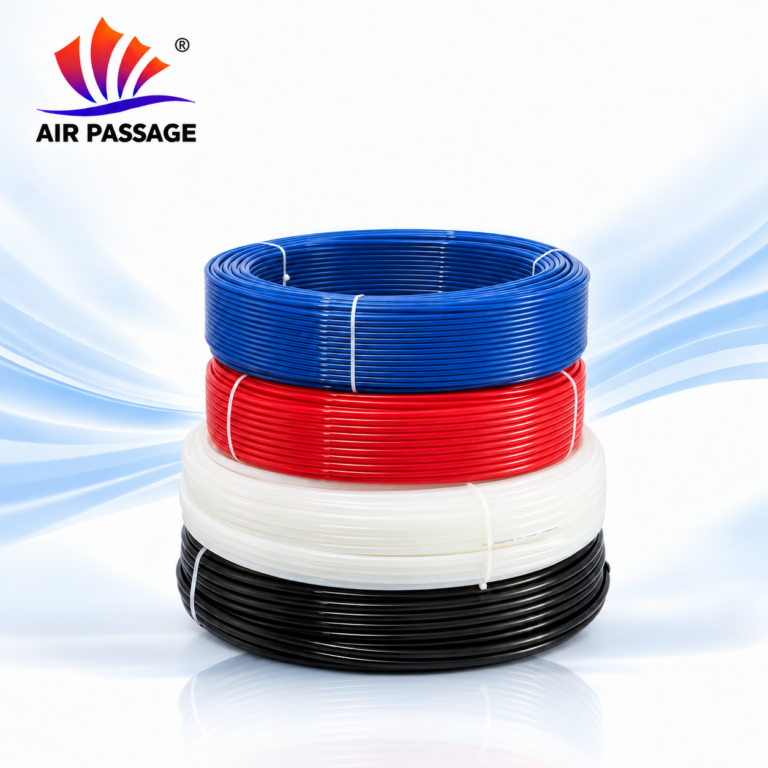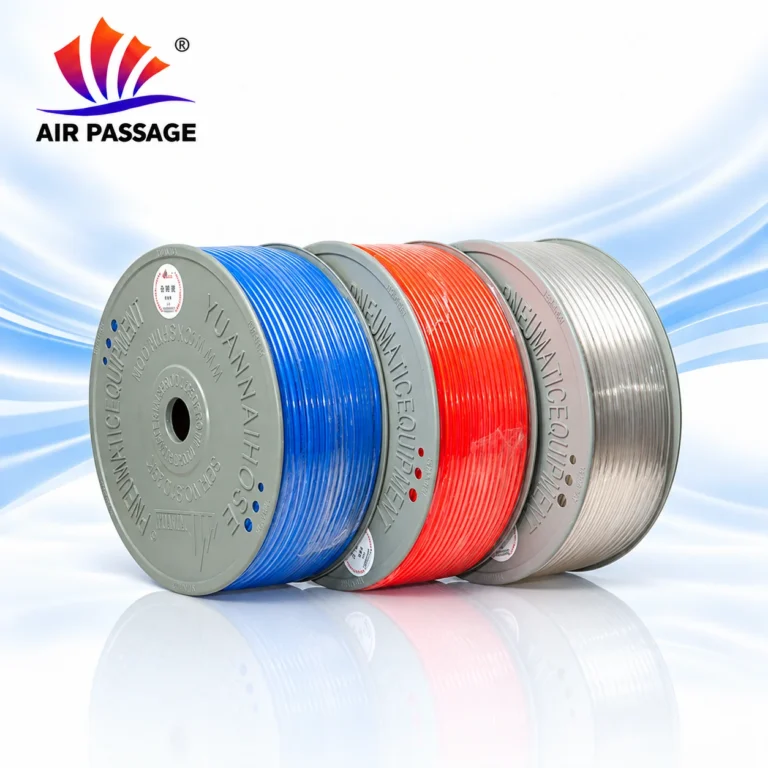
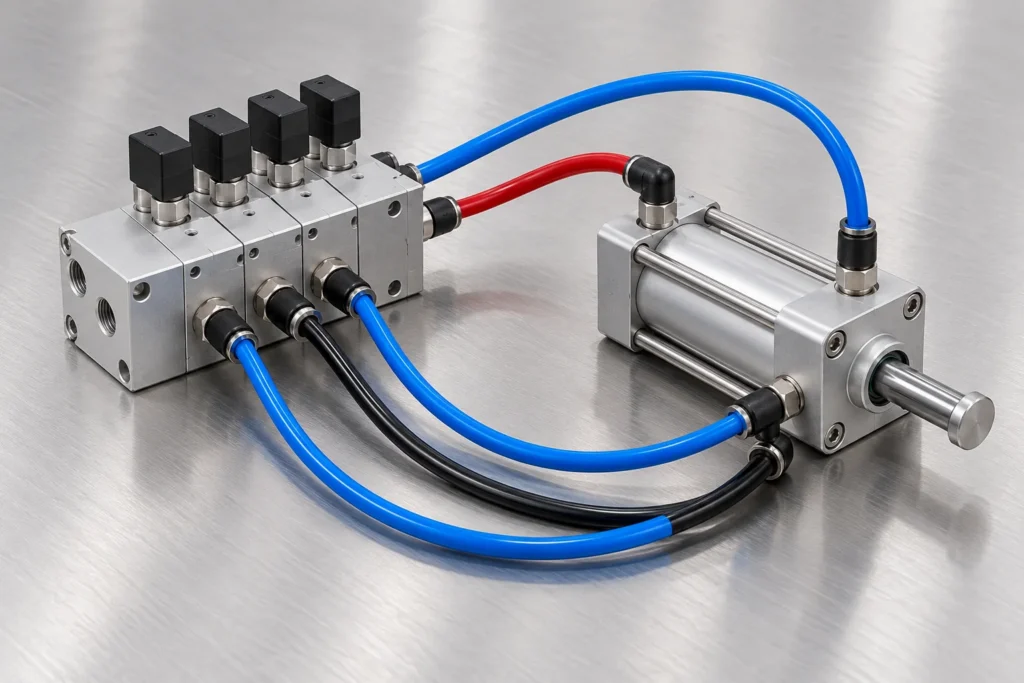
Pneumatic tubing and compressed air tubing carry pressurized air from compressors, filter-regulator-lubricator (FRL) units, and manifolds to valves, cylinders, and air tools. This comprehensive pneumatic tubing guide covers the essential air line tubing types, pressure ratings, sizing verification, and performance checks required for selecting high-reliability plastic tubing for compressed air systems.
Quick answer: what should you confirm first?
Start with the four items that decide most of the selection: the outside and inside diameter the fitting requires, the working pressure at the actual operating temperature, the medium and environment around the tube, and the space available for bends. Material choice follows from those four, not the other way round.
Pneumatic Tubing Types: Selecting Plastic Tubing for Compressed Air
Four material families cover most pneumatic work. Each one is a starting point rather than an approval: final selection uses the model table for the exact product, including wall thickness, pressure rating at temperature, and the fitting specification.
| Family | Typical characteristic | Common use | Where to check |
|---|---|---|---|
| PU (polyurethane) | Flexible, tolerant of repeated movement | Robotic cells, moving axes, hand tools | PU tubing |
| PA6 (nylon 6) | Stiffer, good abrasion behavior | Fixed machine routes, panel wiring | PA6 nylon tubing |
| PA12 (nylon 12) | Lower moisture uptake than PA6 | Routes with humidity or dimensional stability needs | PA12 nylon tubing |
| PE (polyethylene) | Low cost, simple duty | Air and water lines without tight bends | PE tubing |
Fluoropolymer tubing — PTFE, FEP and PFA — is a separate group used where chemical resistance, temperature range or cleanliness matters more than cost. If the line carries solvents, acids or high-purity media, read the selection guide as a different problem, starting from the medium rather than from the air supply.
Deep dives: the industrial tubing materials overview compares all families; the PE tubing guide and the PTFE, FEP and PFA comparison cover two of them in detail.
Pneumatic Tubing Selection: Five Engineering Steps for Industrial Automation
The order matters. Each step narrows the candidates before the next one is applied, which is why a material name alone cannot answer the question.
1. Record the installation
Note whether the tube stays fixed or moves, how many cycles the movement has, and how much space exists around each bend. A moving axis and a fixed panel route can use the same material family and still need different models.
2. Confirm the dimensions
Outside diameter, inside diameter and wall thickness are three separate figures. Two tubes with the same outside diameter can differ in wall thickness, flow area and pressure capability. The guide to ID, OD and wall thickness explains how to read them together.
3. Check pressure at the operating temperature
A pressure rating is only meaningful with the temperature attached to it. Ratings in a model table are given at a stated temperature; using that number at a higher temperature overstates the capability. The working pressure and temperature review covers how to read the derating.
4. Check the medium and the environment
Compressed air is rarely the only thing the tube meets. Oil from the compressor, coolant mist, cleaning agents, sunlight and ambient heat all affect the choice. Record them before comparing models.
5. Match the fitting
The fitting manufacturer defines the tube specification it accepts, including tolerance and hardness. A tube that fits mechanically can still leak or release under pressure if it is outside the fitting specification.
Sizes: reading the numbers on a pneumatic tube
Metric tubing is normally specified as outside diameter × inside diameter, for example a 8 × 6 tube with a 1 mm nominal wall. Inch tubing uses the same logic with imperial figures. The convention in a catalogue is not universal, so confirm which figure is quoted before comparing two suppliers.
Flow depends on the inside diameter, not the outside. When a line feels restricted, check the bore before changing the pressure setting. The size guide includes a worked example and a note on how a standards body describes dimensional measurement.
Working pressure and burst pressure
Working pressure is the limit for continuous service under stated conditions. Burst pressure is the point of failure in a test. They are not interchangeable, and a safety factor is already embedded in the working figure, which is why the two numbers should never be compared directly.
Temperature, cycling and the fitting assembly all reduce the usable limit. For a route with repeated pressure pulses, treat the published working pressure as an upper bound rather than a target.
Bend radius and routing
Minimum bend radius is quoted for the tube, usually measured to the centerline, and it assumes the tube is not supported or stretched. A bend tighter than the published value kinks the wall, narrows the bore and concentrates stress at the fitting. The routing checklist explains how to measure the space you actually have.
Keep a straight length at each fitting before the first bend, and separate fixed routes from moving ones. Mixing the two on one run is a common cause of fatigue failure near the connection.
Fittings and connections
Push-to-connect fittings, compression fittings and barbed fittings each accept a defined tube specification. Confirm the insertion depth, the tube hardness range and whether a support sleeve is required for softer tubing. On pneumatic automation equipment, the fitting choice often decides the tube model rather than the reverse.
Tubing or hose: which one fits the job?
Tubing is rigid enough to hold a route without support and connects with push-to-connect or compression fittings. Hose is reinforced and is used where the line is dragged, coiled or exposed to abrasion. A machine can use both: tubing inside the panel, hose on the moving arm. The deciding question is whether the run needs to hold a shape or survive being handled.
Air quality and oil carry-over
Compressor air is not clean air. Oil carry-over, condensate and particles reach the tube, and the effect depends on the compound. Polyurethane is affected by some oils and by hydrolysis in warm, humid conditions; nylon absorbs moisture and changes dimension slightly; fluoropolymers tolerate a wider range of media but cost more. If the system uses lubricated air, state it in the inquiry rather than assuming dry air.
Color, marking and identification
Color is a working aid, not a specification. Many plants use color to separate air lines from water, or to mark a pressure zone. If color matters for maintenance, record it with the order, together with any required printing such as size, material or a part number. Note that color compounds can differ between production batches, so a color match is a separate requirement from the dimensional and pressure specification.
Common specification mistakes
- Choosing by material name without a model number.
- Comparing outside diameter only, and ignoring the bore.
- Using a pressure rating without the temperature it belongs to.
- Assuming a tube that fits a fitting is approved for it.
- Routing a moving axis through a bend tighter than the published radius.
Specification checklist
| Item | What to record |
|---|---|
| Tube | Material family and exact model |
| Dimensions | OD × ID, nominal wall thickness, tolerance |
| Duty | Working pressure, operating temperature, cycles |
| Medium | Air, oil carry-over, coolant, cleaning agent |
| Route | Fixed or moving, bend space, length per run |
| Connection | Fitting type and the tube specification it accepts |
| Delivery | Quantity, roll length, color, marking, packaging |
Where this guide goes next
Each section above has a dedicated page with more detail: PU versus nylon selection, PU versus PE tubing, ID, OD and wall thickness, working pressure and temperature, and bend radius and routing. For purchase preparation, use the quotation checklist, and for incoming goods the receiving inspection checklist.
Frequently Asked Questions: Compressed Air Tubing & Selection
What is the difference between rigid pipe headers and flexible compressed air tubing?
Rigid pipe headers (such as aluminum, copper, or galvanized steel) serve as primary plant air mains distributing bulk flow at high volume with minimal pressure drop. Flexible compressed air tubing (such as PU or nylon) serves as secondary drop lines and machine hookups, connecting air preparation units (FRLs), solenoid valve manifolds, and moving cylinders with push-to-connect fittings.
What factors determine plastic tubing selection for industrial compressed air systems?
Key criteria include: working pressure at peak operating temperature (accounting for thermal derating), dynamic flexibility requirements (drag chains vs. stationary routing), ambient chemical and UV exposure, fitting compatibility (metric or imperial outside diameter tolerances), and regulatory compliance (such as FDA or RoHS).
What is pneumatic tubing made of?
The common families are polyurethane, nylon 6, nylon 12 and polyethylene. Fluoropolymers such as PTFE, FEP and PFA are used where chemical resistance or cleanliness is the deciding requirement.
How do I know which size to order?
Take the fitting specification first: it defines the outside diameter the fitting accepts. Then confirm the inside diameter needed for flow and the wall thickness needed for pressure, using the model table.
Can I use the same tube for air and water?
Sometimes, but not automatically. Water changes the pressure and temperature picture, and additives or treatment chemicals may not suit the tube compound. Confirm the medium with the model data.
Why does a tube fail at the fitting rather than in the run?
The connection concentrates stress and constrains movement. A missing straight length, an over-tight bend at the fitting, or a mismatch between tube hardness and fitting specification are common causes.
Do I need a different tube for a moving axis?
Usually yes. Repeated flexing favors a more flexible compound and a longer bend radius, and the cycle count becomes part of the specification rather than an afterthought.
Tell us what the line has to do
Send the dimensions, working pressure, temperature, medium and route details, and we will confirm which models match. If the route is still at design stage, include a sketch or the fitting list — that is usually faster than a material question.
Send your requirements or review the full product range.
Matching tube to fittings: see push-in fittings and tubing.
To estimate air velocity and pressure drop for a chosen size and length, use the compressed air flow calculator.
Sources and scope
- PU Tubing — English data sheet (v3-20261020)
- PA6 Nylon Tubing — English data sheet (v4-20261020)
- PA12 Nylon Tubing — English data sheet (v5-20261020)
- Polyether Tubing — English data sheet (v2-20261020)
Use these documents for the identified product models and stated test conditions. General material comparisons and selection checklists do not establish a different grade’s rating, fitting compatibility or project approval. Confirm the exact model, medium, temperature, pressure and required evidence before ordering.
Background on materials: SMC notes that tubing comes in a variety of material types to accommodate different media, and that its primary polyurethane series are ether-based for immunity to hydrolysis while other series may be ester-based for increased strength but may hydrolyze. This is another manufacturer’s description, not a rating for our tubing.
Content review: zhangkexin · Marketing
Review scope: market information and document references.