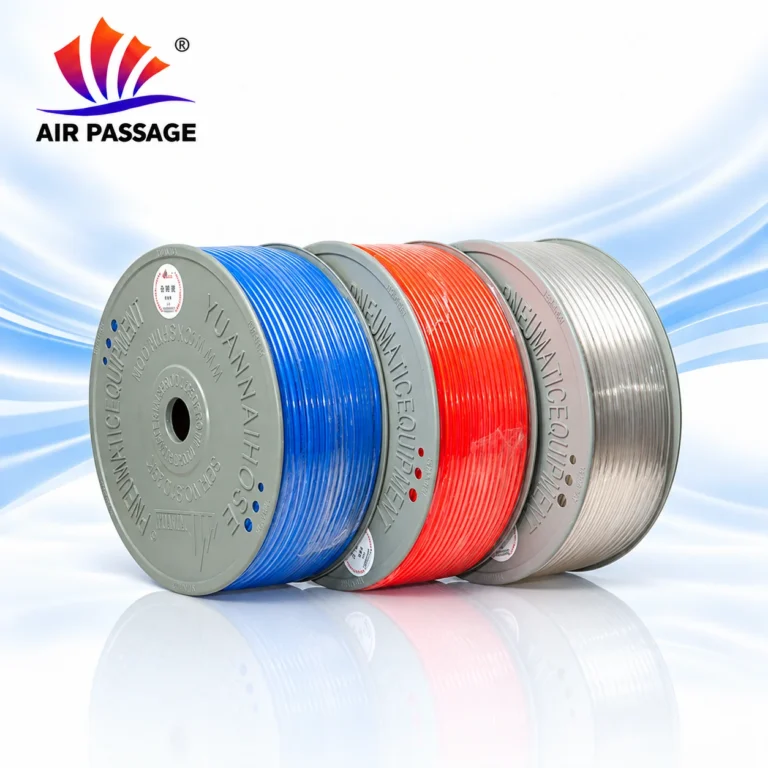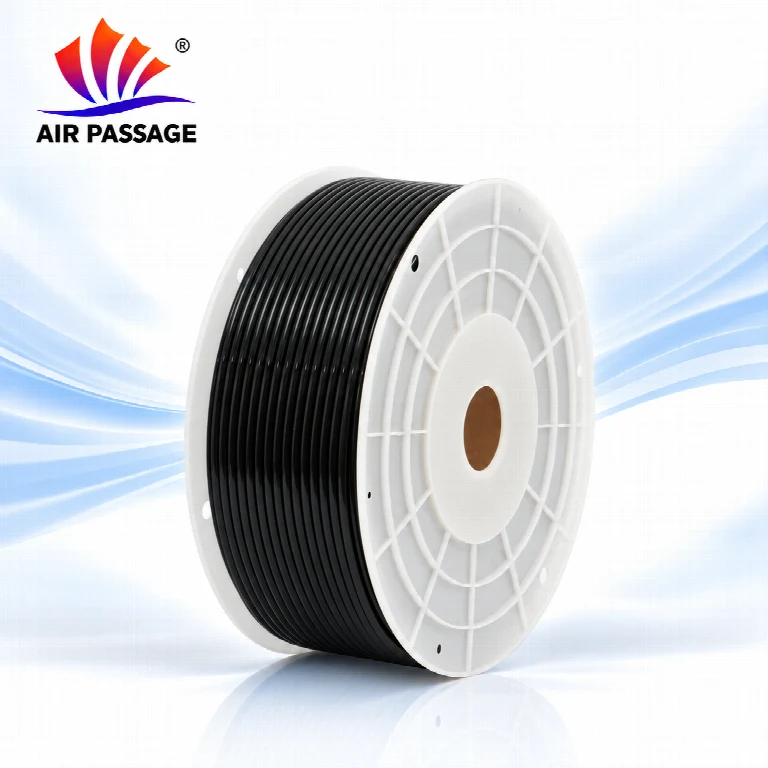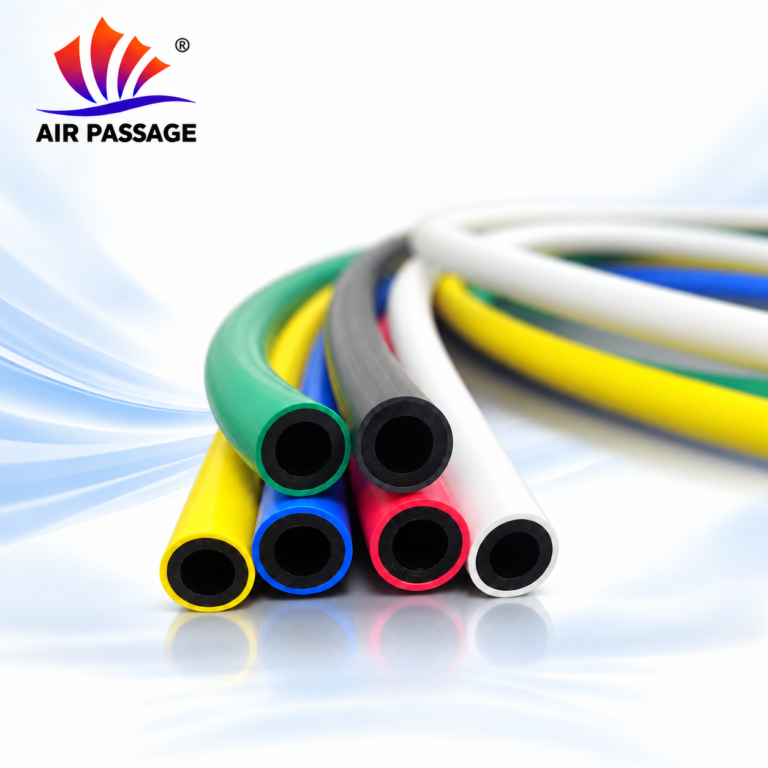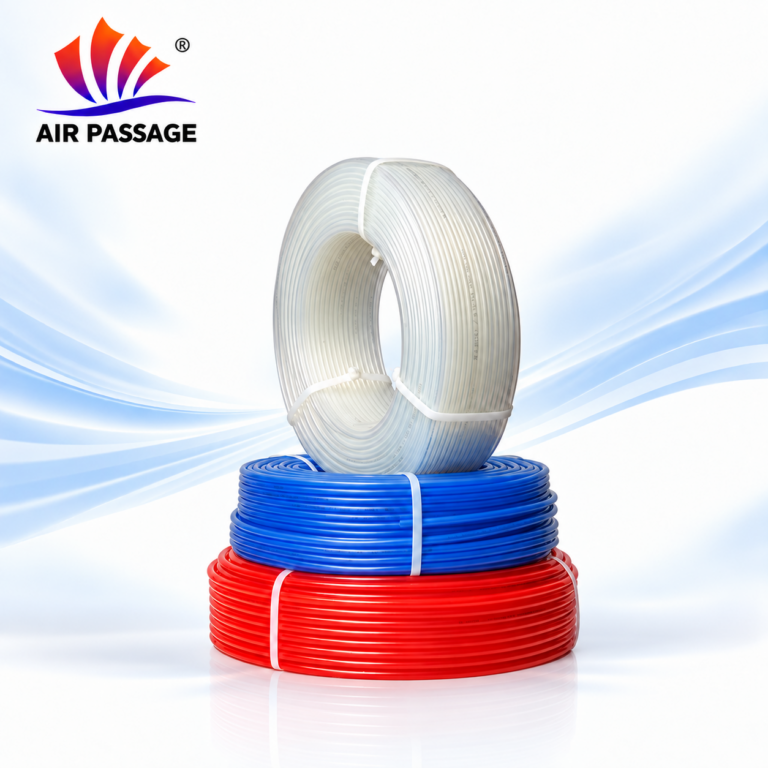
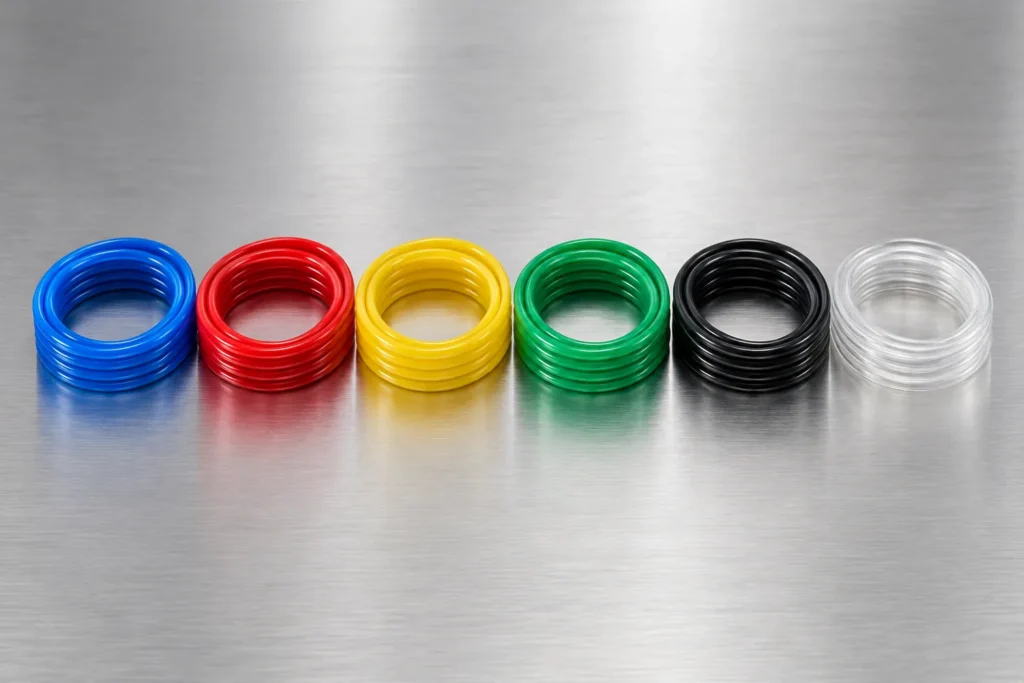
There is no universal color code for pneumatic tubing. In the manufacturer catalogs we checked, each maker lists its own colors and its own ordering codes, and none of them gives a color a fixed meaning such as “blue means air.” Treat tube color as a way to tell lines apart on your own machine, and write down what each color means on your drawings.
Quick answer. Pneumatic tubing color is a convention you set yourself. Festo lists blue, yellow, green, red, black, clear and white for its PUN inch tubing, and Pisco lists black, red, orange, ocher, yellow, green, blue, clear blue, transparent and milk-white for its UB polyurethane tubing, but the colors available, and the codes used to order them, differ between makers. Identify the material by the model code and data sheet, never by color.
What the catalogs show
| Maker and range | Colors listed | How colors are ordered |
|---|---|---|
| Festo, PUN inch polyurethane tubing | Blue, yellow, green, red, black, clear, white | Two-letter suffix in the type code: BL blue, GE yellow, GN green, RT red, SW black |
| Pisco, UB polyurethane tubing | Black, red, orange, ocher, yellow, green, blue, clear blue, transparent, milk-white | Color code in the model number; not every size comes in every color |
The two catalogs do not share a code system. The letters are Festo’s own (German-derived, such as SW for black), and a color that is available in one size may not be offered in another size in the same range. Neither catalog assigns an application, pressure or medium to a color.
How to use color on your machine
- Pick a scheme and write it down. For example one color for main supply, one for each actuator group, one for vacuum. Put it on the machine drawing and in the maintenance notes.
- Keep it consistent per site. If you buy from more than one supplier, confirm that the second supplier can match your colors before you standardize.
- Do not use color to identify the material. A black PU tube and a black PA12 tube look alike. The model code on the data sheet, and the print on the tube if it is marked, identify the material. See PU vs nylon tubing.
- Do not use color to decide the pressure rating. Working pressure depends on the material, the wall and the temperature; read it from the model table. The tubing size chart and the pressure and temperature review give the figures.
- Allow for clear tubing. Clear tubing lets you see moisture or oil in the line, but it carries no marking for the medium.
- State the color when you ask for a quotation. Add the color you need to your request, together with the model, length and quantity. The quotation checklist lists the fields.
Pneumatic tubing color code FAQ
Is there a standard color code for pneumatic tubing?
We found no industry-wide color code in the catalogs we checked. Each manufacturer lists its own colors and ordering codes.
What does blue pneumatic tubing mean?
Nothing fixed. Blue is a common choice for air supply on many machines, but that is a convention at the machine builder or site, not a rule built into the tubing.
Does tube color change the working pressure?
No. Working pressure is set by the material, the wall thickness and the temperature, and it is listed per model in the data sheet.
Can I tell PU from nylon tubing by color?
No. Both can be made in the same colors. Use the model code, the print on the tube and the data sheet.
Why is clear tubing used?
It lets you see moisture, oil or debris in the line. It does not mean the tube is for a particular medium.
Sources and scope
- Festo, PUN inch polyurethane tubing data sheet (color codes in the type code)
- Pisco, UB polyurethane tubing catalog page (available colors)
The catalog details describe those two ranges only. YUANNAI TUBE tubing is available in clear, milky white, blue, black and red, and other colors can be made to custom order. Send the model and the color you need when you ask for a quotation.
Content review: zhangkexin · Marketing
Review scope: market information and document references.