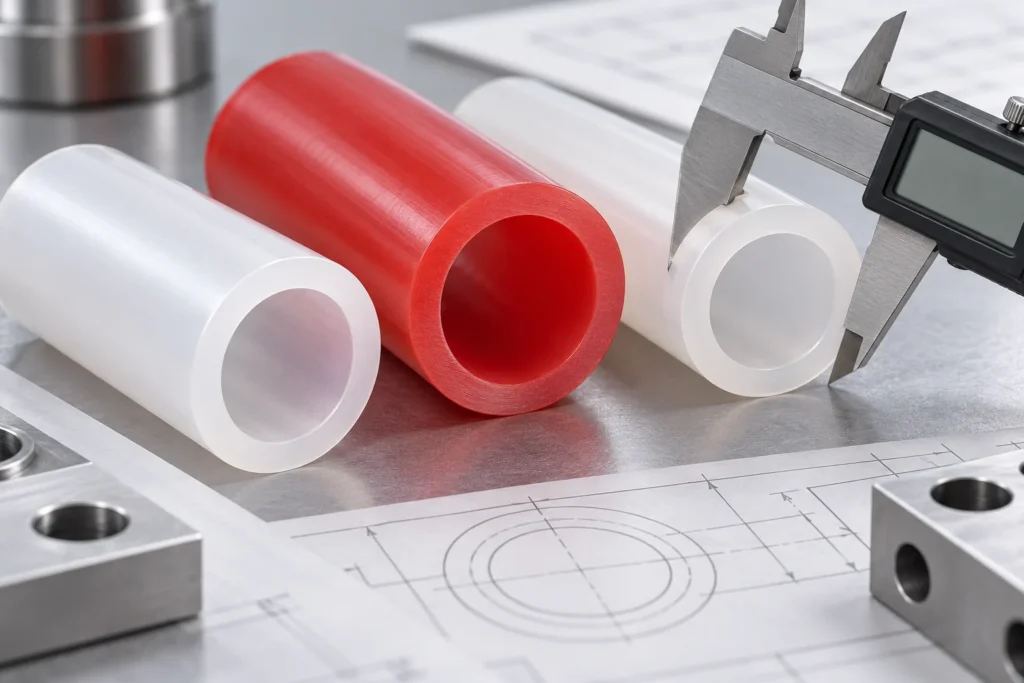
Tubing Dimensions: Outer Diameter (OD), Inner Diameter (ID) & Wall Thickness
A tube is specified by three tubing dimensions: outside diameter (OD) sets how it engages a push-in fitting, inside diameter (ID) sets flow rate and pressure drop, and tubing wall thickness governs pressure rating. Nominal wall thickness is (OD − ID) ÷ 2. To check pneumatic tubing tolerances, measure OD and ID with calibrated optical or contact instruments (how to measure tubing OD and ID is covered below).
Part of the pneumatic tubing guide.
Every size we produce, with OD, ID, wall and working pressure, is in the tubing size chart.
Inner diameter and outer diameter
Inner diameter (ID) describes the internal bore. Outer diameter (OD) describes the outside of the tube. Always identify which measurement a drawing or purchase request specifies.
Tubing Wall Thickness Calculation & Pressure Tolerance
For a round tube with a uniform wall, nominal wall thickness is (OD − ID) ÷ 2. Dimensions should use the same unit. A nominal value does not define manufacturing tolerance.
Confirm the complete specification
Include dimensional tolerances, material, operating conditions and connection requirements. For high-pressure lines and chemical transfer applications, wall thickness and material grade matter more than for standard pneumatic sizes., material, operating conditions and connection requirements. Dimensions alone do not establish pressure rating or chemical compatibility.
Pneumatic tubing size chart: read ID and OD together
A pneumatic tubing size should identify ID, OD and units. In a product size chart, keep the model code attached to the dimensions and check which diameter the fitting requires. A single diameter does not describe the complete tube.
- Identify the required material and model.
- Record OD and ID in the same unit.
- Check the fitting specification and the supplied dimensional tolerance.
- Review pressure, temperature and installation requirements separately.
Use the actual model tables for PU tubing, PA6, PA12 or PE tubing. This guide explains how to size pneumatic tubing; it does not replace a flow calculation or establish that an unlisted size is available.
Worked dimensional example
For OD 8 mm and ID 5 mm, nominal wall thickness is (8 − 5) ÷ 2 = 1.5 mm. This is a calculation example, not a product specification or an acceptance limit.
Prepare a dimensional inquiry →
How to Measure Tubing OD and ID: Metrology Standards & Tolerances
ASTM International publishes a test method for measuring pipe dimensions. Its scope reads:
“This test method covers the determination of diameter, wall thickness, and length dimensions of thermoplastic pipe.”
The method is written for thermoplastic pipe, not for small-bore tubing. Use it as a reference for which dimensions are measured, not as a tubing tolerance, and ask the supplier which measurement method and tolerance apply to the tubing you order.
In our own finished-tubing inspection, calipers measure outside diameter, inside diameter and tube ends where the tolerance is looser than ±0.05 mm, and a micrometer or projector is used for wall thickness and tighter tolerances. Length is checked from the meter marks at each end of the coil. See how we inspect finished tubing before it ships.
References
- ASTM International — D2122-22, Standard Test Method for Determining Dimensions of Thermoplastic Pipe and Fittings (accessed 21 October 2026).
Frequently Asked Questions: Tubing Dimensions & Measurement

How do you accurately calculate tubing wall thickness from outside and inside diameter?
Nominal wall thickness is calculated using the formula: W = (OD − ID) ÷ 2. For example, an 8 × 5.5 mm polyurethane tube has a nominal wall thickness of (8.0 − 5.5) ÷ 2 = 1.25 mm. In precision extrusion, wall concentricity should be verified around the full 360-degree circumference.
Why does push-in fitting reliability depend strictly on tube outside diameter (OD) and roundness/ovality?
Push-in fittings grip and seal entirely against the tube outside diameter. If tube ovality exceeds 0.15 mm or OD falls below nominal tolerance, the internal elastomeric O-ring cannot exert uniform radial sealing pressure, leading to micro-leaks under vibration. YUANNAI TUBE maintains dual-axis laser OD monitoring during extrusion to guarantee ±0.05 mm to ±0.10 mm tolerances.
Is ID or OD the size printed on the tube?
Either may be printed depending on the manufacturer. Always confirm both from the model table rather than relying on a single printed figure.
How do I convert inch tubing sizes to millimeters?
One inch equals 25.4 mm. Convert the nominal size, then check the actual tolerance from the model table, because the nominal figure is not the exact measurement.
Does the same OD always mean the same ID?
No. Wall thickness determines the inside diameter for a given outside diameter, and a different wall thickness changes both the bore and the pressure rating.
Sources and scope
- PA6 Nylon Tubing — English data sheet (v4-20261020)
- PA12 Nylon Tubing — English data sheet (v5-20261020)
- PU Tubing — English data sheet (v3-20261020)
- Polyether Tubing — English data sheet (v2-20261020)
Use these documents for the identified product models and stated test conditions. General material comparisons and selection checklists do not establish a different grade’s rating, fitting compatibility or project approval. Confirm the exact model, medium, temperature, pressure and required evidence before ordering.
Content review: zhangkexin · Marketing
Review scope: market information and document references.