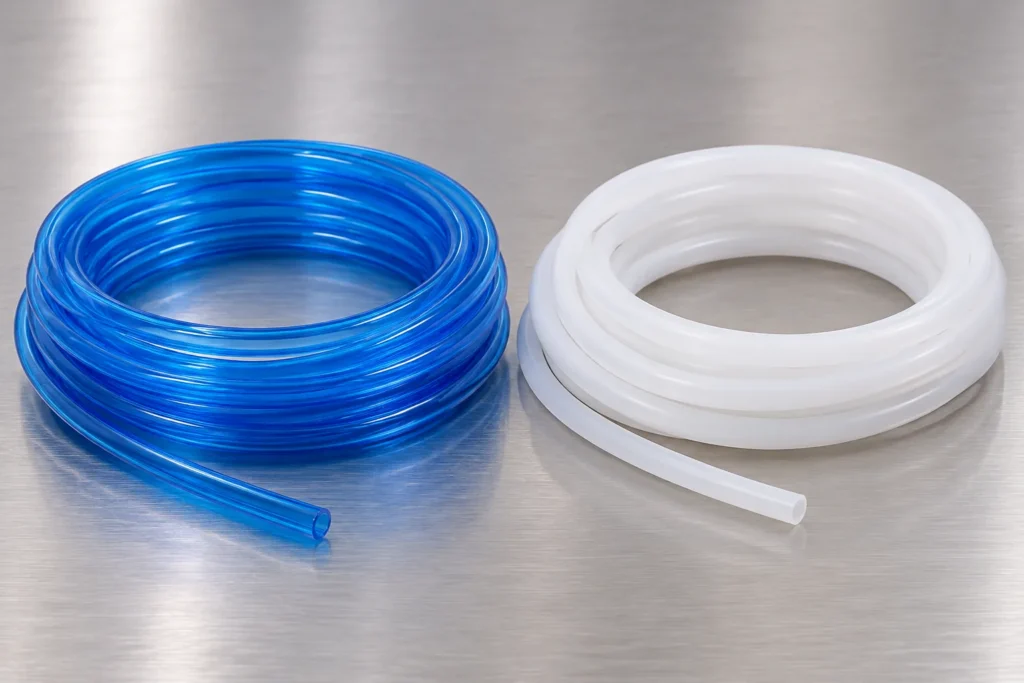
Polyurethane (PU) tubing and polyethylene (PE) tubing are both sold in coils for air lines, and in the sizes we make they share the same outside and inside diameters. What differs is how much pressure they carry, how tightly they bend and the temperature range they are listed for. This comparison uses our own model tables for both ranges, so you can choose from the numbers.
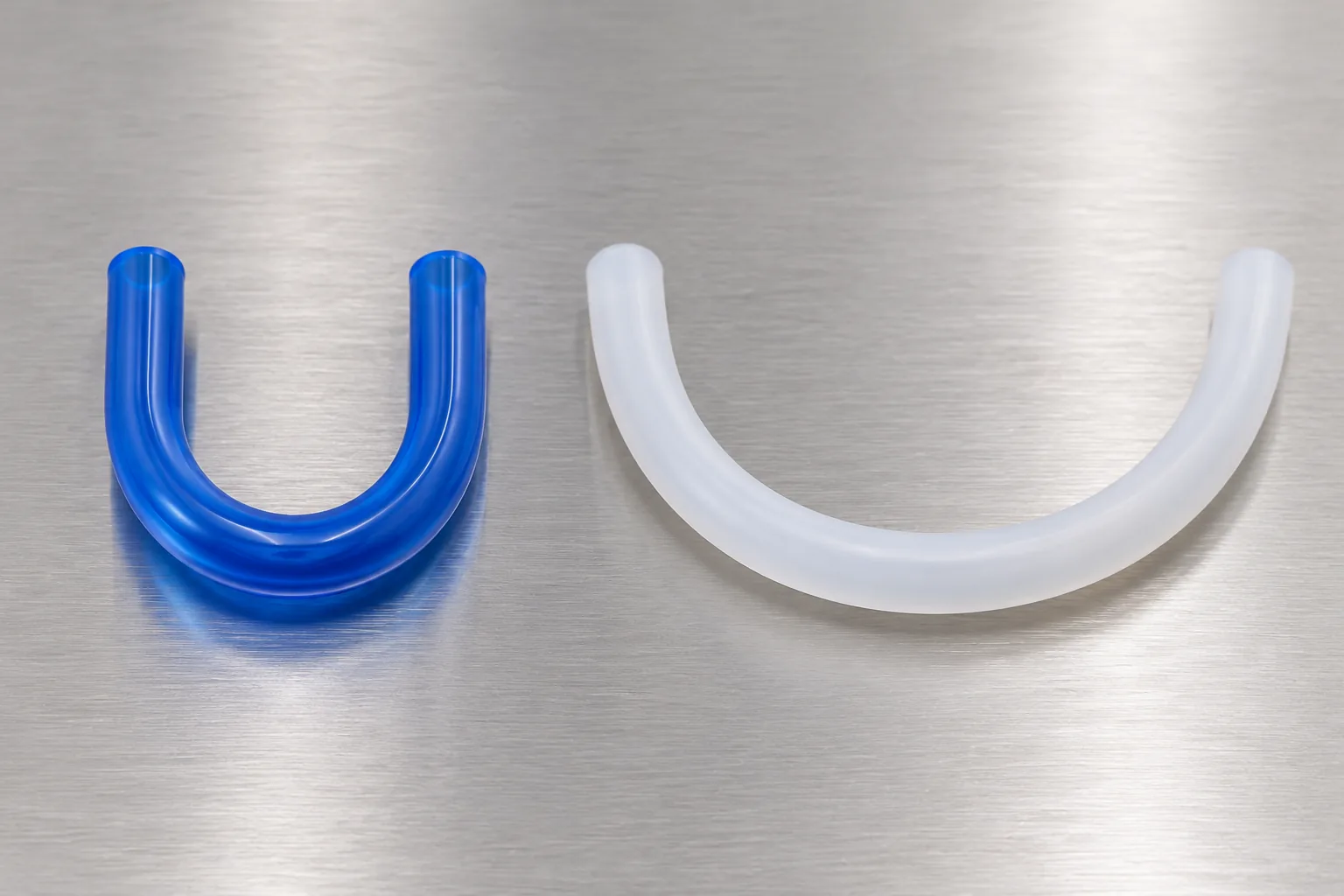
Quick answer. In the ten metric sizes we make in both materials, PU carries the same or a higher working pressure in nine and bends to a smaller radius in all ten; for example 8 bar versus 6 bar and 10 mm versus 20 mm on the 4 × 2.5 tube. PU is listed for −20 °C to +55 °C in compressed-air, inert-gas and vacuum service; PE is listed for ambient-temperature water and compressed air, with −10 °C to +50 °C in air service.
Same sizes, different ratings
Ten metric model codes exist in both ranges with identical dimensions and the same ±0.10 mm tolerance, so a direct comparison is possible. Every figure comes from our own published model tables, stated at 23 °C. Working pressure is the design rating; bend radius is the smallest radius the tube is listed for.
| Model (same size) | YN-PU working pressure | YN-PE working pressure | YN-PU min. bend | YN-PE min. bend |
|---|---|---|---|---|
| 0425 (4×2.5) | 8 bar | 6 bar | 10 mm | 20 mm |
| 0640 (6×4) | 8 bar | 6 bar | 15 mm | 30 mm |
| 0850 (8×5) | 7 bar | 7 bar | 20 mm | 40 mm |
| 0855 (8×5.5) | 6 bar | 5 bar | 22 mm | 45 mm |
| 0860 (8×6) | 5 bar | 6 bar | 25 mm | 50 mm |
| 1065 (10×6.5) | 7 bar | 6 bar | 25 mm | 50 mm |
| 1080 (10×8) | 6 bar | 4 bar | 30 mm | 75 mm |
| 1280 (12×8) | 7 bar | 5 bar | 50 mm | 60 mm |
| 1410 (14×10) | 7 bar | 5 bar | 70 mm | 80 mm |
| 1612 (16×12) | 7 bar | 3 bar | 95 mm | 110 mm |
Two rows do not follow the general pattern. On the 8 × 5 tube the two ratings are equal, and on the 8 × 6 tube the PE rating is the higher one. Read the row for your own model rather than the trend. The full tables, including burst pressure, are on the PU tubing page and the PE tubing page.
Fractional sizes differ between the two ranges (PU lists 1/8″, 1/4″, 3/8″, 1/2″ and 3/4″; PE stops at 1/2″), so compare those sizes from the model tables. For every size in one place, see the tubing size chart.
Temperature and media
- PU: listed for −20 °C to +55 °C, for compressed air, inert gases and vacuum circuits. Liquid lubricating oil lines are reviewed against your requirements.
- PE: listed for ambient-temperature water and compressed air. The air-service range is −10 °C to +50 °C; the water-service range is 0 °C to +55 °C, and freezing is not permitted.
Pressure and temperature ratings are listed separately on the data sheets, so check the working pressure at your operating temperature; see working pressure and temperature.
Material properties on the data sheets
The two data sheets state their properties on different bases, so the figures should not be set side by side as a ranking.
| Property | PU (YN-PU) | PE (YN-PE) |
|---|---|---|
| Hardness | 98 ± 2 Shore A | Not stated on the data sheet |
| Tensile strength | ≥ 42 MPa | Approx. 10 MPa at yield, approx. 16 MPa at break |
| Elongation at break | ≥ 480% | Approx. 750% |
| Other stated values | Tear strength ≥ 115 kN/m; abrasion volume loss ≤ 30 mm³ | Density approx. 0.920 g/cm³; melt mass-flow rate approx. 2.0 g/10 min |
The PU values are stated as limits (≥, ≤) and the PE values as approximate typical values. For hardness on a Shore scale, see how to write it into a specification in how to specify tubing.
Colors and packaging
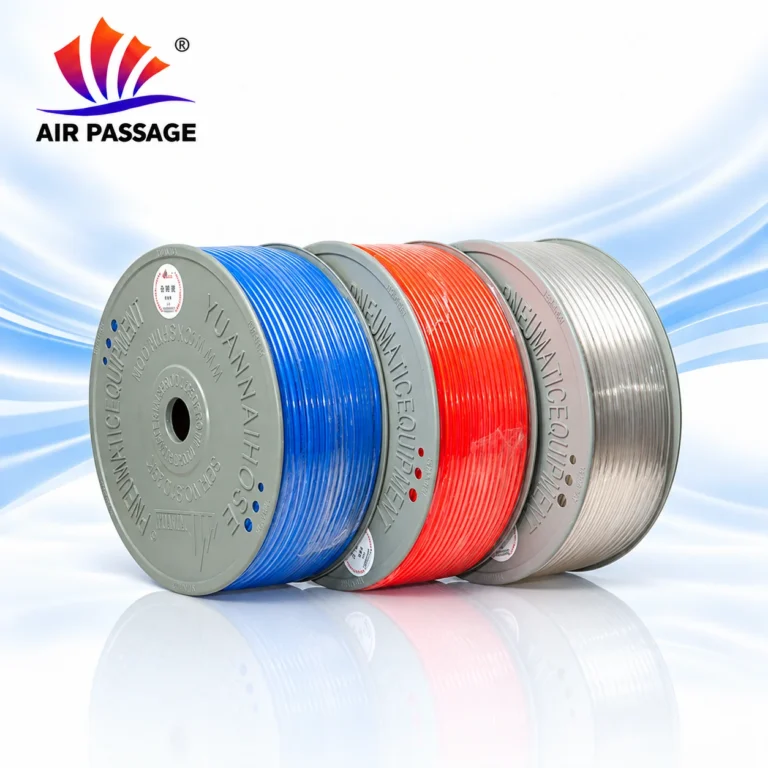
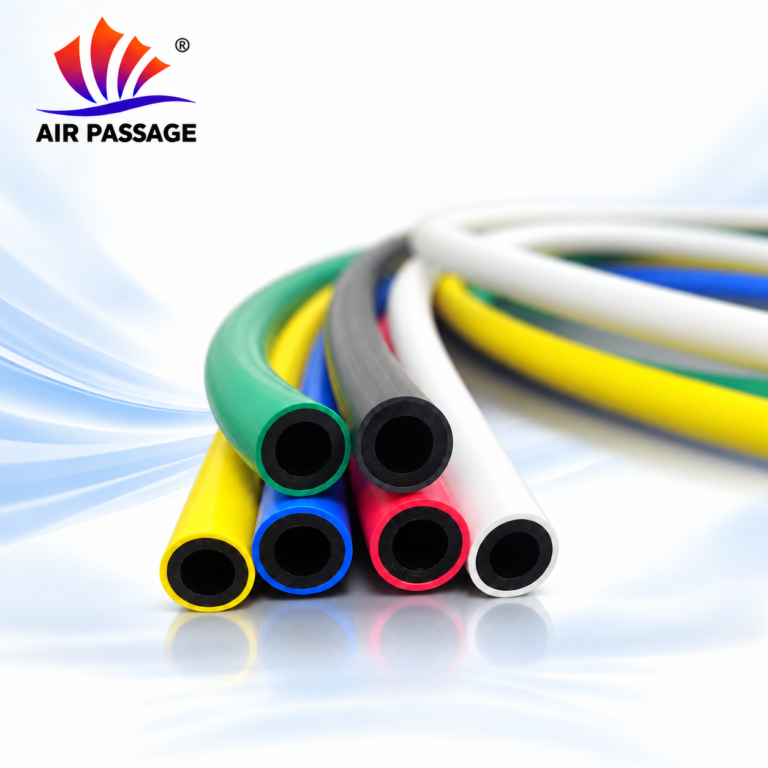
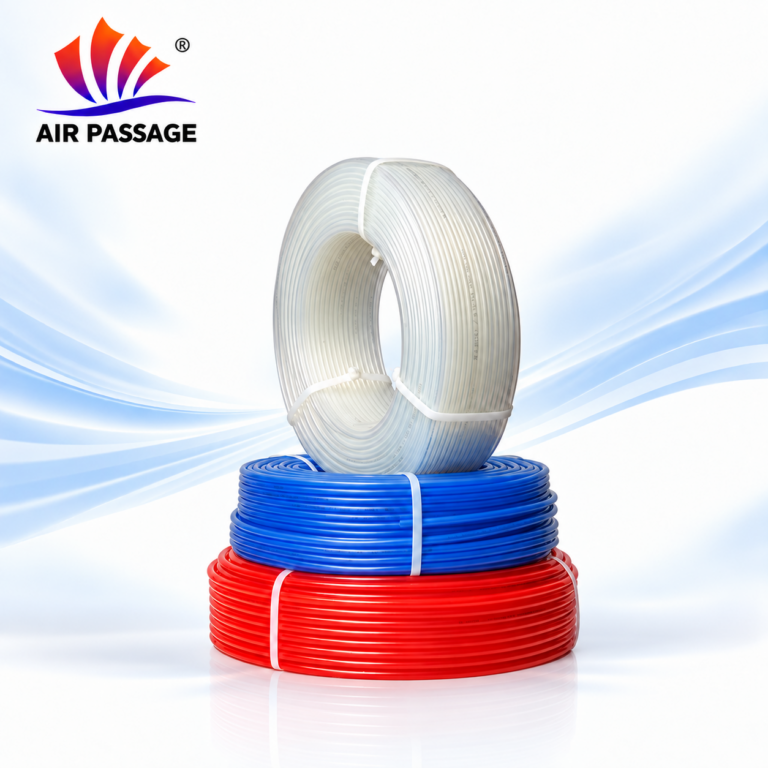
PU standard colors are clear, transparent blue and transparent red, plus solid orange, dark blue, sky blue, black, green and yellow, supplied on engineering-plastic reels or in color boxes. PE standard colors are milky white, dark blue, black, green and yellow (custom colors available), supplied in stretch-film wrapping. Both can carry meter-marked printing, your brand logo and model identification.
How to choose in four checks
- Medium. Compressed air, inert gas or vacuum: both ranges are listed for air. Water at ambient temperature: the PE data sheet lists it; the PU data sheet does not.
- Temperature. Below −10 °C or above +50 °C in air service, check the PU range first.
- Pressure. Read the working pressure for your exact model in each table; the ranges overlap and the order is not the same in every size.
- Routing. Tight bends and moving parts point to the smaller bend radius, which is PU in all ten shared sizes.
For a hot-water application where standard PE was not enough, see the PE-RT dishwasher tubing case.
If the choice is between two PU grades, see polyether vs polyester PU tubing; for the wider PE range, the PE tubing guide; for the full picture of materials, the pneumatic tubing guide. For quotation details, send the size, length, quantity, medium and temperature range; the quotation checklist lists every field.
PU vs PE tubing FAQ
What is the difference between PU and PE tubing?
In our model tables, the two share the same ten metric sizes, but PU is listed for −20 °C to +55 °C in air, inert-gas and vacuum service and bends to a smaller radius, while PE is listed for ambient-temperature water and compressed air.
Is PU or PE tubing better for compressed air?
Both are listed for compressed air. For the same size, PU is listed at the same or a higher working pressure in nine of the ten shared metric sizes and with a tighter bend radius in all ten. Check the row for your model.
Can PE tubing be used for water?
The PE data sheet lists ambient-temperature water service from 0 °C to +55 °C, and freezing is not permitted. The PU data sheet scope covers compressed air, inert gases and vacuum circuits.
Which one bends more tightly?
PU, in every size the two ranges share. The 4 × 2.5 tube is listed at 10 mm for PU and 20 mm for PE.
Do PU and PE tubing fit the same push-in fittings?
Push-in fittings grip the tube outside diameter, and the ten shared sizes have the same OD in both materials. Confirm the fitting against the supplied tolerance; see matching tubing to fittings.
Sources and scope
Use these documents for the identified product models and stated test conditions. The comparison covers YUANNAI TUBE YN-PU and YN-PE models only and does not describe other manufacturers’ PU or PE tubing. Confirm the exact model, medium, temperature and pressure before ordering.
Content review: zhangkexin · Marketing
Review scope: market information and document references.