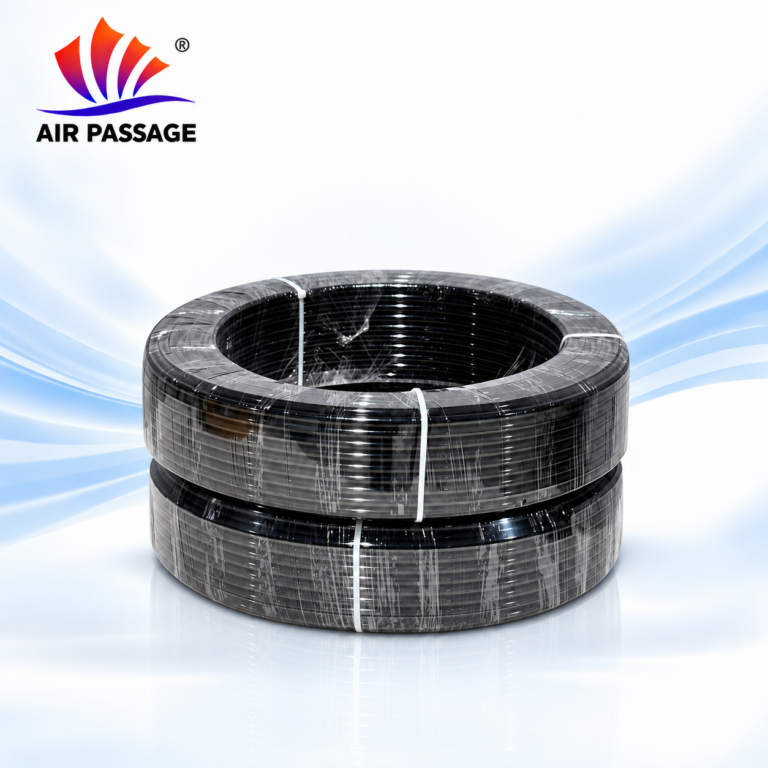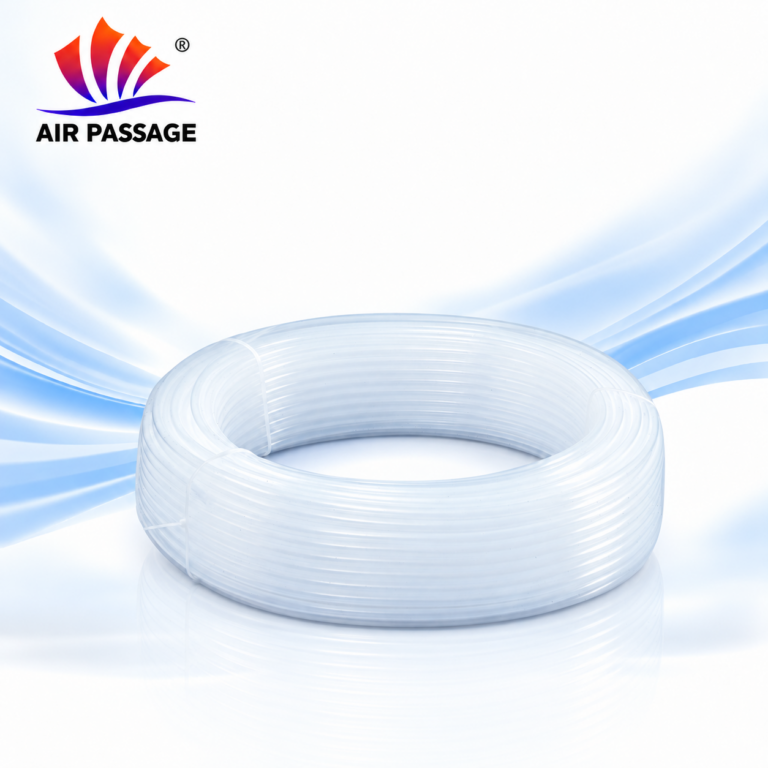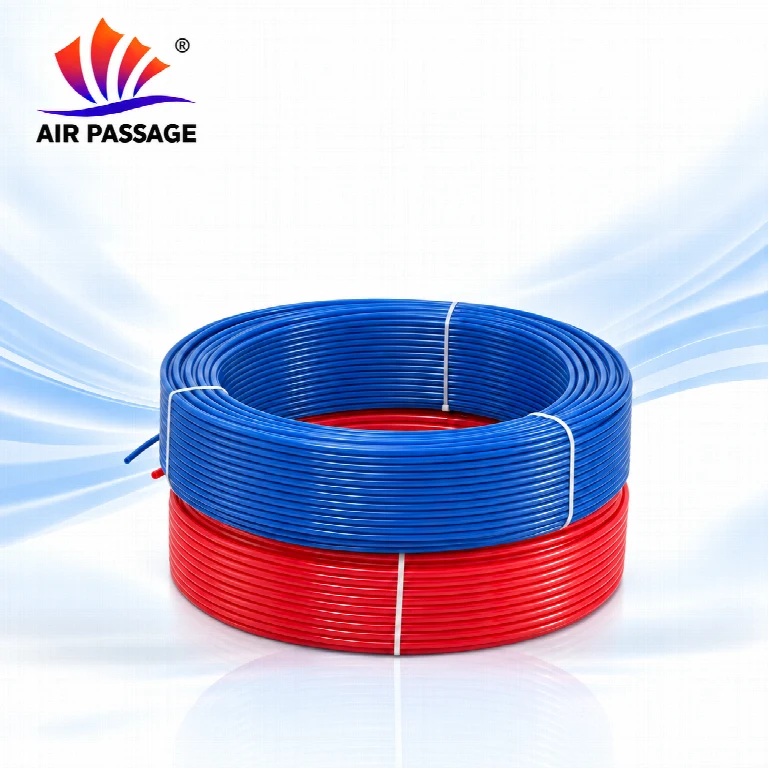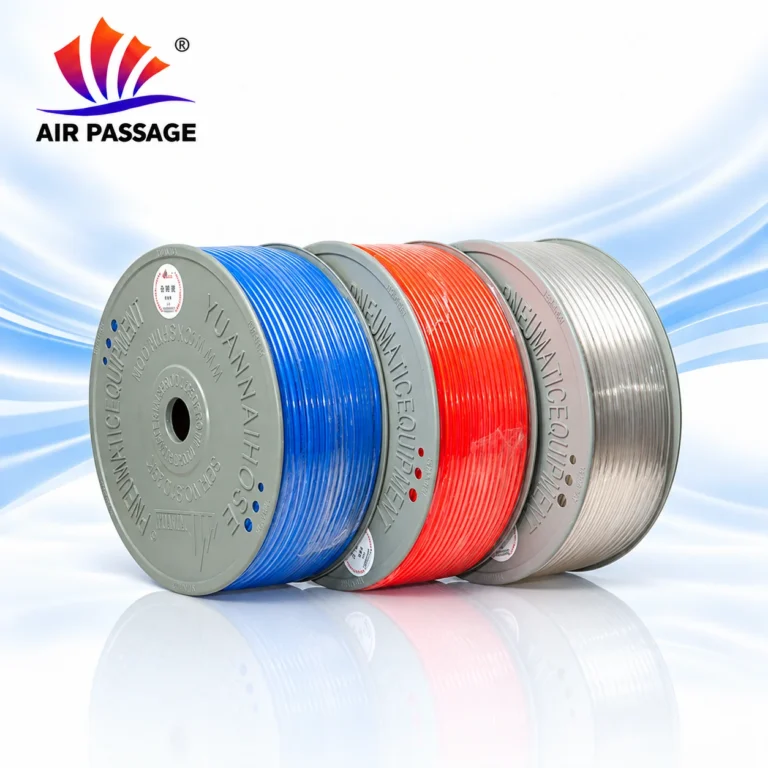
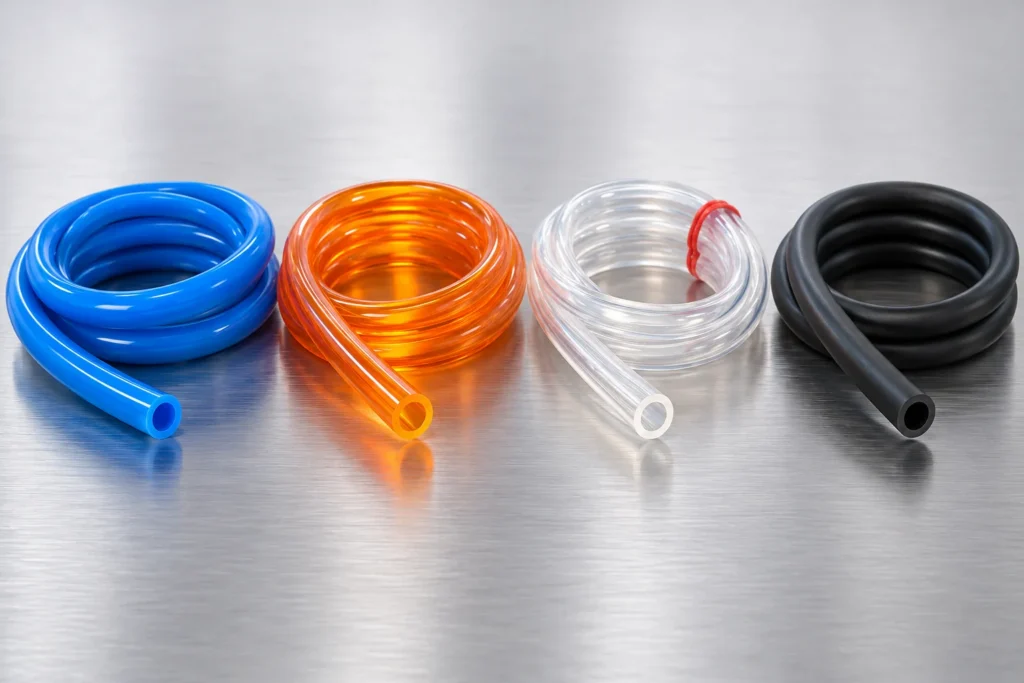
Four polymer families cover most industrial tubing materials and pneumatic tubing materials: polyurethane (PU), nylon (PA6/PA12), fluoropolymers (FEP/PFA) and polyethylene (PE). Each suits different working pressures, operating temperatures, chemical exposure and routing demands across compressed air tubing types and industrial automation.
Quick answer. Choose by the medium and the working pressure at the actual operating temperature first, then by flexibility and cost. PE covers economical air and water lines, PU covers moving parts, PA6 and PA12 cover higher pressures and abrasion, and FEP or PFA cover chemicals, heat and high-purity media. Every material below links to a size table with its own working pressures — no figure on this page replaces the model table.
The Four Industrial Tubing Materials at a Glance (Pneumatic Tubing Materials Matrix)
| Material | Stand-out property | Typical jobs | Where it falls short |
|---|---|---|---|
| PE (polyethylene) | Cost, dimensional stability in wet lines | Low-to-medium pressure air and water runs | Tight bends, high pressure |
| PU (polyurethane) | Elasticity, repeated flexing | Moving axes, tools, recoil hose | Some oils; hydrolysis in warm humid air |
| PA6 / PA12 (nylon) | Stiffness, higher pressure, abrasion | Fixed routes, high-pressure circuits, fuel and oil lines | Moisture uptake (PA6), cost above PE |
| FEP / PFA | Chemical resistance, temperature, purity | Solvents, acids, high-purity and hot lines | Cost |
These are starting points for selection. Each family page carries the full model table — inside and outside diameter, tolerance, working pressure, burst pressure and minimum bend radius — and the fitting specification decides the final size as often as the material does.
PE — the economical workhorse
Polyethylene is the lowest-cost material in the range and keeps its dimensions well in wet environments, which makes it the default for coolant, wash and general air lines that do not bend tightly. Working pressures in our table run from 3 to 8 bar depending on size, so it is not the material for high-pressure circuits. The PE tubing guide lists all fourteen standard sizes — ten metric and four fractional — with pressures and bend radii.
PU — for lines that move
Polyurethane is elastic: it survives millions of flex cycles on robot arms, moving tools and push-in fittings that see constant handling. The trade-offs are lower pressure than nylon and sensitivity to some oils and to hydrolysis in warm, humid compressed air. If the route is static, PU buys flexibility you are not using — see the PU vs nylon selection checklist for the full trade-off, and the polyether vs PU comparison for the grade-level difference inside polyurethane itself.
PA6 and PA12 — nylon for pressure and wear
Nylon tubing is stiffer than PU and carries higher pressures, which is why it dominates high-pressure pneumatic circuits, lubrication and fuel lines, and routes exposed to abrasion. PA6 is the general-purpose grade; PA12 absorbs less moisture, which keeps dimensions and properties more stable in wet or humid service and makes it the usual choice for higher-pressure and outdoor-facing work. Both are metric-standard in this range; check the PA12 tubing page for the pressure table.
FEP and PFA — fluoropolymers for chemistry and heat
Where the medium is aggressive — solvents, acids, bases — or the line runs hot, or the fluid must stay ultrapure, the fluoropolymers are the family that survives. FEP is the more economical of the two and transparent; PFA handles higher temperatures and purer service at a higher price. The PTFE vs FEP vs PFA comparison walks through the differences and when each is worth the cost.
How to Choose Between Compressed Air Tubing Types & Polymer Families
Four checks, in this order:
1. The medium. Compressed air, water and oils point to different families, and lubricated air changes the answer again. If the line carries anything corrosive, start from the chemical comparison rather than from pressure.
2. Working pressure at the operating temperature. Every rating is valid at a stated temperature only; the working pressure and temperature review explains how derating works. For cycling circuits, treat the table value as a ceiling, not a target.
3. Flexibility and routing. Moving lines need PU; fixed routes take nylon or PE. Each size has a minimum bend radius, and bending below it kinks or overstresses the tube — the bend radius guide covers the layout practice.
4. Fittings. Push-to-connect, compression and barbed fittings each accept a defined hardness and tolerance. On pneumatic automation equipment, the fitting specification usually decides the tube model rather than the reverse.
From material to model
Once a family is settled, the model table does the rest. Our ranges cover metric sizes from 4 mm to 16 mm outside diameter and fractional sizes from 1/8″ to 1/2″, with tolerance ±0.10 mm on both diameters; coil lengths and custom sizes are confirmed at quotation. Send the inside and outside diameter (or the fitting model), total length, quantity, the medium, its temperature range and the working pressure at that temperature — the quotation checklist lists every field in order. The full range is on the product overview, and the pneumatic tubing guide covers the selection method family by family.

Frequently Asked Questions: Industrial & Pneumatic Tubing Materials
Which pneumatic tubing material is best for high-vibration robotic arm drop lines?
Polyurethane (PU) tubing is the premier choice for high-flex robotic articulating joints and drag chains because of its outstanding kink recovery, high elasticity (Shore 98A / 95A), and fatigue resistance across millions of flex cycles. Semi-rigid nylon (PA12) is preferred for static distribution runs where higher pressure or abrasion resistance is needed.
Can standard pneumatic tubing materials handle aggressive oil mist or solvent washdown?
Standard polyester polyurethane degrades in the presence of synthetic ester oils or aggressive solvent washdowns. For harsh chemical environments or oil mist carry-over, PA12 nylon provides excellent resistance against petroleum oils, while FEP and PFA fluoropolymers offer total chemical inertness against virtually all industrial acids, bases, and solvents.
Which tubing material is the most chemical resistant?
The fluoropolymers — PFA first, then FEP — tolerate the widest range of media including solvents and acids. PE, PU and nylon each fail against specific chemicals, so the medium decides: start from the fluoropolymer comparison when chemistry is the constraint. For published chemical resistance ratings by material, see Chemical Resistant Tubing: How to Compare PA, PU, PE, FEP and PFA.
Is nylon stronger than polyurethane tubing?
For pressure, generally yes — nylon (PA6/PA12) carries higher working pressures and resists abrasion better, while polyurethane wins on flexibility and flex life. The right pick depends on whether the line moves; the selection checklist compares them point by point.
What is the cheapest tubing material for compressed air?
Polyethylene is normally the lowest-cost option for static air runs within its pressure ratings (3–8 bar depending on size). Compare the per-meter price against PU and PA only after confirming the pressure and fitting requirements; see the PE tubing guide for the size table.
Can one tube material handle both air and water?
PE is commonly used for both low-pressure air and water lines, and nylon handles wet service well — PA12 in particular changes little with moisture. PU is the one to check first in warm, humid conditions because of hydrolysis. Confirm with the medium and temperature stated in your inquiry.
What information decides the material for a new line?
Five items: the medium, the working pressure at the operating temperature, the flexibility the route needs, the fittings that will be used, and the environment around the tube (abrasion, heat, sunlight). Send them through the quotation checklist and the material choice comes back with the confirmed model.
Next step. Compare the full ranges on the product overview, or go straight to a family: PE, PU, PA6, PA12, FEP, PFA.
Once the material is chosen, how to choose a tubing supplier covers the checks to run before you order.
Sources and scope
- PE Tubing — English data sheet (v1-20261021)
- PU Tubing — English data sheet (v3-20261020)
- PA6 Nylon Tubing — English data sheet (v4-20261020)
- FEP Tubing — English data sheet (v6-20261020)
Use these documents for the identified product models and stated test conditions. General material comparisons and selection checklists do not establish a different grade’s rating, fitting compatibility or project approval. Confirm the exact model, medium, temperature, pressure and required evidence before ordering.
Background on the resins: Arkema, a PA12 manufacturer, states that PA12 has significantly lower moisture uptake than PA6, and the BASF Elastollan material properties document states that polyether polyols give the highest hydrolysis resistance in thermoplastic polyurethane. These are resin manufacturers’ statements, not ratings for our tubing.
Content review: zhangkexin · Marketing
Review scope: market information and document references.