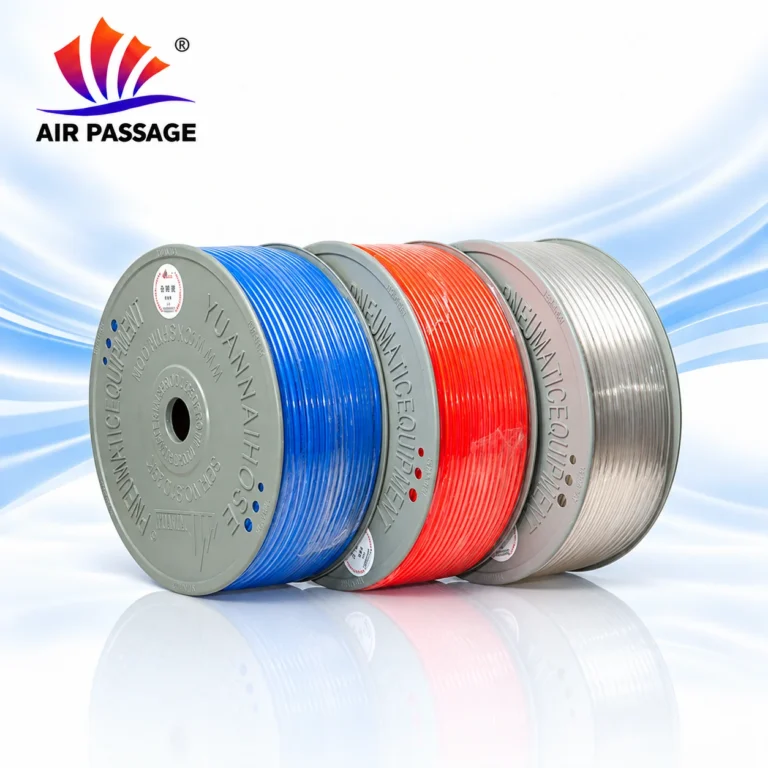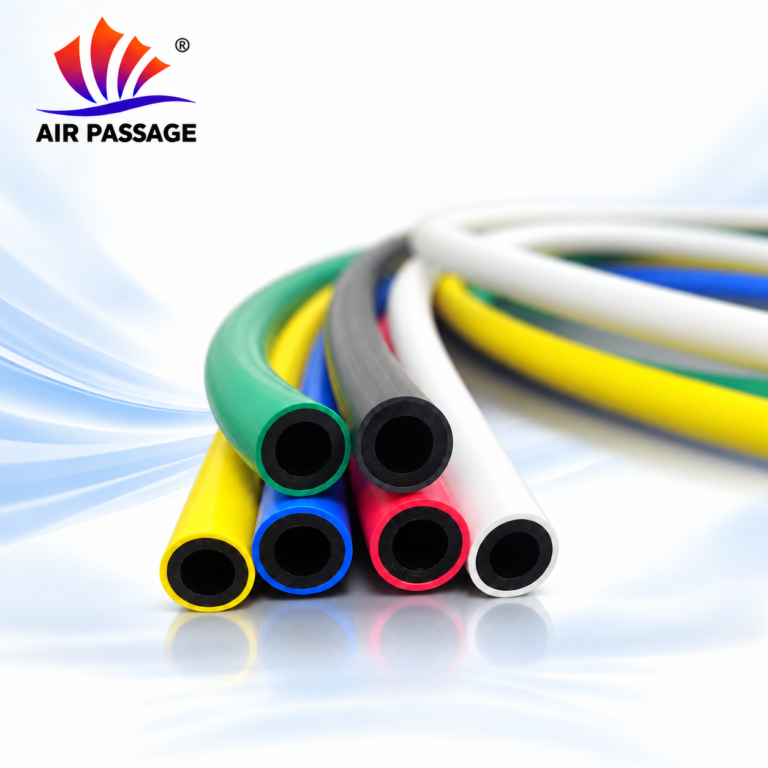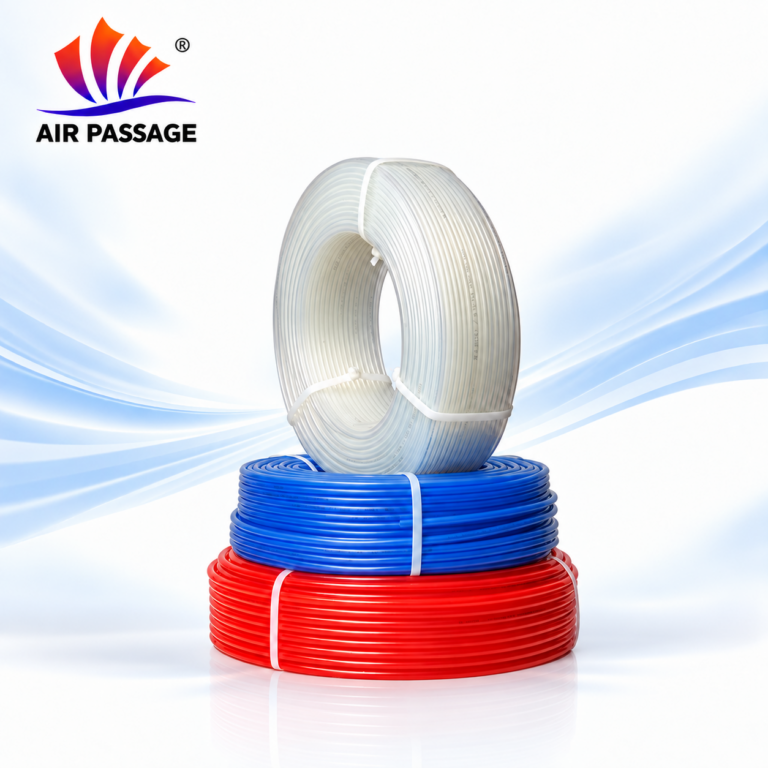
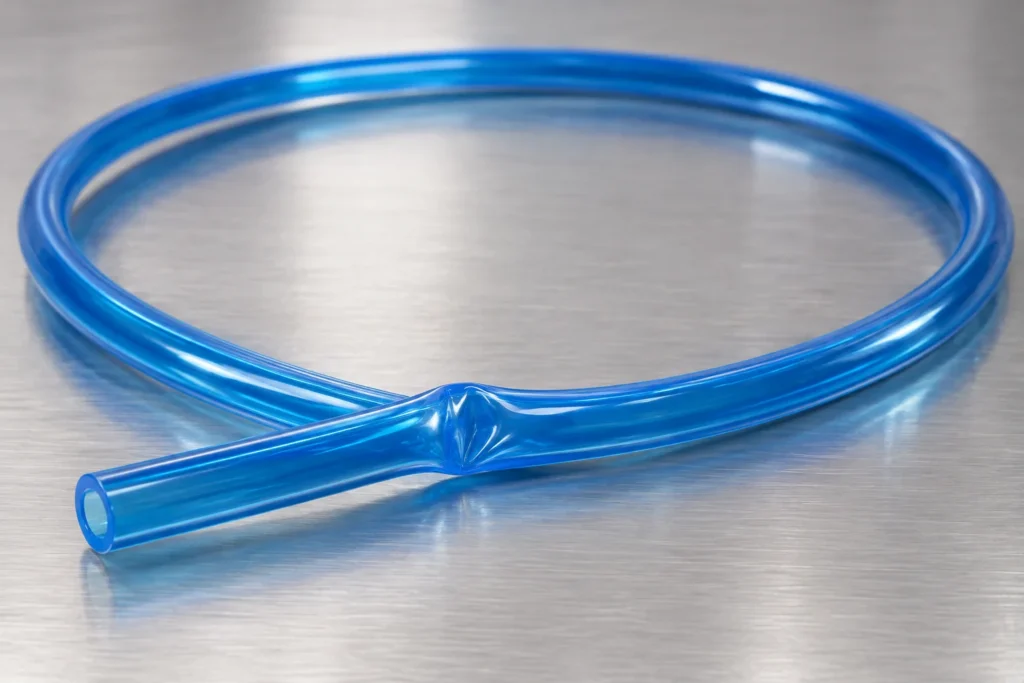
Air tubing kinks when it is bent tighter than its minimum bend radius, bent right next to a fitting, twisted, or asked to move when it was installed as fixed piping. A kink flattens the bore, cuts flow and weakens the wall. This guide explains each cause and shows, from our own model tables, how the wall thickness and outside diameter set the radius a tube can take.
Quick answer. Keep every bend at or above the tube’s listed minimum radius, including the bend next to the fitting; avoid twisting and pulling; use coiled tubing where the line moves; and replace a tube that has kinked, twisted or been crushed. In our PU tubing the minimum radius is 2.5 times the outside diameter on models 0425, 0640, 0850 and 1065, and it rises when the wall gets thinner.
Why tubing kinks
- The radius is too small. SMC’s precautions state that if the bending radius is less than the minimum value, the fitting may be damaged, or the tubing may crack or be crushed.
- The bend is at the fitting. The same document says the bend radius in the vicinity of the fitting should be at least the minimum bending radius of the tubing. A tube that leaves a fitting at a sharp angle is the most common place for a kink to start.
- The tube is twisted or pulled. SMC warns against twisting, pulling, moment loads, vibration and impact on fittings or tubing, which can crush, burst or release the tube.
- The tube moves, but was installed as fixed piping. SMC states that tubing other than coiled tubing requires stationary installation. Where the line has to move, use coiled tubing or follow the maker’s moving-use guidance.
- The tube is too short. Tubing changes length under pressure, so a line pulled tight can be forced into a bend when it is pressurized. SMC asks for a sufficient length margin for this.
How the radius is set: wall thickness and diameter
The minimum bend radius in a data sheet is a tested value, and it depends on the outside diameter, the wall and the material. In our PU model table the radius follows a clear pattern. For the same 8 mm outside diameter, a thinner wall needs a larger radius:
| YN-PU model | Outside × inside diameter | Wall | Min. bend radius |
|---|---|---|---|
| 0850 | 8 × 5 mm | 1.5 mm | 20 mm |
| 0855 | 8 × 5.5 mm | 1.25 mm | 22 mm |
| 0860 | 8 × 6 mm | 1.0 mm | 25 mm |
| 1065 | 10 × 6.5 mm | 1.75 mm | 25 mm |
| 1080 | 10 × 8 mm | 1.0 mm | 30 mm |
The same holds for PE: the 8 × 5, 8 × 5.5 and 8 × 6 tubes are listed at 40, 45 and 50 mm. If a route is tight, choose the heavier wall for the same outside diameter, or a smaller outside diameter, rather than forcing a thin-wall tube around a corner. The full radius table by size and material is in pneumatic tubing bend radius, and the two materials are compared size by size in PU vs PE tubing.
How to stop kinks
- Check the radius at design time. Take the minimum bend radius for your model from the data sheet and check it against the routing, especially at fittings.
- Leave a straight run at each fitting. Let the tube leave the fitting straight for a short length before it bends. Use an angled (elbow) fitting where the tube must turn at once.
- Support the line. Clip or clamp the tube so that its weight does not pull it into a bend. Do not let it hang from a fitting.
- Allow length. Cut the tube a little long so that pressure changes do not pull it tight (see how to cut plastic tubing).
- Do not twist the tube. Push it straight into the fitting and release any twist along the run before you pressurize.
- Use the right construction for moving parts. For moving equipment see the coiled air tubing guide.
- Replace damaged tube. SMC’s maintenance list includes twisting or crushing of the tubing as a reason to replace it. A kinked tube that has whitened or creased should not be put back in service.
Is some tubing kink-resistant?
Some manufacturers sell polyurethane tubing described as highly flexible and kink resistant; Festo’s PUN tubing is an example. That describes how well a tube tolerates bending, not an exemption from the minimum radius in the data sheet. Compare the radius figure for the exact model, as in the table above.
Air tubing kinking FAQ
Why does my air tubing keep kinking?
The usual causes are a bend tighter than the minimum radius, a sharp bend at the fitting, twisting, or a fixed-piping tube that is being moved. Check the radius for your model first.
How do I keep tubing from kinking?
Keep bends at or above the listed minimum radius, leave a straight run at the fitting, support the line and leave enough length so it is not pulled tight.
Does a thinner wall kink more easily?
In our PU and PE model tables, for the same outside diameter, the thinner-wall tube has the larger minimum bend radius. For example the 8 × 6 PU tube is listed at 25 mm and the 8 × 5 at 20 mm.
Can I straighten a kinked tube?
A kinked section is deformed and weakened. SMC lists twisting or crushing of tubing as a reason to replace it, so cut out the damaged length or replace the tube.
What can I use instead of straight tubing for moving parts?
Coiled tubing is made for lines that extend and retract. See the coiled air tubing guide.
Sources and scope
- SMC, fittings and tubing precautions (bending radius near fittings, stationary installation, replacement)
- PU Tubing — English data sheet (v3-20261020)
- PE Tubing — English data sheet (v1-20261021)
The radius figures are from the YUANNAI TUBE YN-PU and YN-PE model tables and apply to those models only. The routing suggestions are general practice. Confirm the minimum bend radius for your exact model before you route a line.
Content review: zhangkexin · Marketing
Review scope: market information and document references.