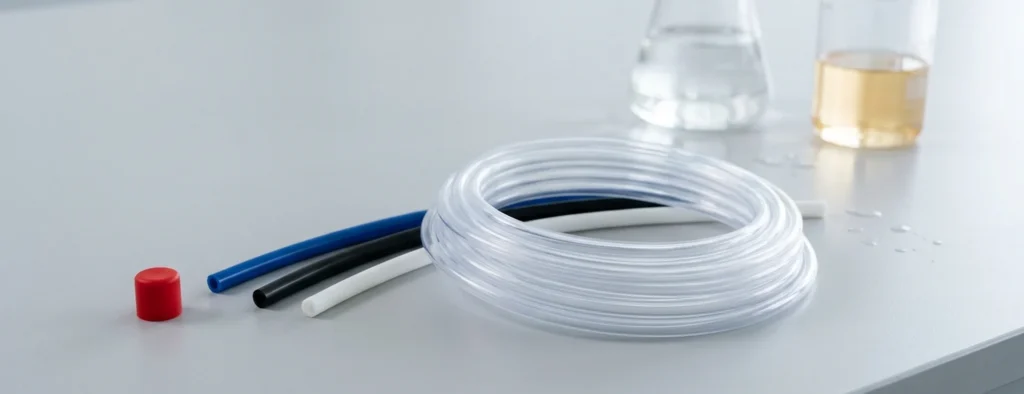
Chemical resistant tubing: the short answer
No tubing material resists every chemical. Published ratings depend on the chemical, its concentration, the temperature, the exposure time and the pressure, so a rating is a starting point for a shortlist. In the charts and supplier documents cited below, fluoropolymers (FEP and PFA) show the broadest resistance. Nylon (PA6 and PA12) handles oils, greases and many solvents but is rated poor against acids. Thermoplastic polyurethane (TPU) suits water, humid air and low-temperature flexing but swells in aromatic solvents, alcohols and esters. Low-density polyethylene tolerates dilute acids and alkalis but is weaker against aromatic and halogenated solvents.
Use this page to shortlist a material, then confirm your exact medium, concentration and temperature against the supplied data sheet before you order. Send your medium, concentration and temperature and we will review them against the data sheet.
Published chemical resistance ratings by material
The table reproduces the ratings in the Professional Plastics “Chemical Resistance Chart”, a general guide to polymer families. The ratings describe the polymers, not any single tubing grade, and the chart does not state a temperature or concentration. A dash means the chart gives no rating. Polyurethane is not in this chart, so it is covered in the next section.
| Material | Concentrated acids | Dilute acids | Alcohols | Alkalis | Aromatic hydrocarbons | Greases and oils | Halogenated hydrocarbons | Halogens | Ketones |
|---|---|---|---|---|---|---|---|---|---|
| Nylon 6 (PA6) | Poor | Poor | Good | Good-Fair | Good | Good | Good-Poor | Poor | Good |
| Nylon 12 (PA12) | Poor | Fair-Poor | Fair | Good-Fair | Good | Good | Good-Poor | Poor | Good-Fair |
| Polyethylene, low density | Good-Fair | Good | Good | Good | Fair-Poor | Good-Fair | Fair-Poor | Fair-Poor | Good-Fair |
| FEP | Good | Good | Good | Good | Good | Good | Good | Good | Good |
| PFA | Excellent | Excellent | Excellent | Excellent | Excellent | Excellent | — | Excellent | Excellent |
Two points stand out. Neither nylon is rated for acids or halogens, so nylon tubing is a poor fit for acid lines even where it handles oils and fuels well. And the fluoropolymers are the only families in the table without a weak column. For PA12 against PA6, Arkema, a PA12 manufacturer, states that PA12 is superior to PA6 in chemical resistance, including oils, fuels and hydraulic fluids; that is a manufacturer claim without stated test conditions.
Polyurethane (TPU) tubing: what the supplier data says
BASF’s Elastollan TPU brochure documents polyurethane behavior in detail. It describes BASF’s own TPU grades, not our tubing, but the polymer chemistry is the same family.
- Polyester vs polyether: polyester polyols give the highest resistance to mineral oils. Polyether polyols give the highest hydrolysis resistance, the best low-temperature flexibility and resistance to microbiological degradation. Our polyether tubing is ether-based; see polyether vs polyester PU tubing for the model-by-model comparison.
- Acids and alkalis: concentrated acids and alkaline solutions attack TPU even at room temperature. Short-time contact with dilute acids and alkali solutions at room temperature is tolerated.
- Hydrocarbons: saturated hydrocarbons such as diesel oil, isooctane and kerosene cause limited swelling (about 1–3% at room temperature, with no more than 20% loss of tensile strength, largely reversible). Aromatic hydrocarbons such as benzene and toluene cause considerable swelling, with weight gains of up to about 50%.
- Solvents: aliphatic alcohols such as ethanol and isopropanol cause swelling and a loss of tensile strength. Ketones such as acetone and MEK are partial solvents and are unsuitable for long-term use. Esters such as ethyl acetate cause severe swelling, and highly polar solvents such as DMF, DMSO and THF dissolve TPU.
- Oils and fluids: TPU is in principle resistant to lubricating oils and greases, but additives in a lubricant can cause irreversible damage, so test each lubricant. BASF also notes that brake fluid and many hydraulic oils attack TPU.
Fluoropolymers (FEP and PFA): the exceptions that matter
Zeus, a fluoropolymer tubing manufacturer, notes that very few chemicals react with fluoropolymers, naming molten alkali metals, turbulent liquid or gaseous fluorine, chlorine trifluoride and oxygen difluoride. For PFA its chart marks dry fluorine and monoethanolamine as not recommended at 100°C. It also notes that halogenated organic chemicals can be absorbed to a lesser degree, and that this is less evident in FEP and PFA extrusions than in PTFE because they are less permeable. The same source puts responsibility for testing on the end user.
The supplied data sheets for our FEP tubing and PFA tubing list strong acids, strong alkalis, salt solutions (FEP), strong oxidizing agents and organic solvents as the media scope, with the instruction to validate the specific medium and conditions. For the differences between the two, see FEP vs PFA tubing and the PTFE, FEP and PFA comparison.
Media scope in our supplied data sheets
Use the table below as the starting point for each product line. It restates the “media / application scope” line from the data sheet of each product; it is not a compatibility guarantee for any specific chemical.
| Product | Media scope in the supplied data sheet |
|---|---|
| PA6 nylon tubing | Compressed air, lubricating oil, mineral oil, fuels and ethylene-glycol antifreeze |
| PA12 nylon tubing | Compressed air, mineral and hydraulic oil, diesel, petrol and antifreeze; other industrial media need compatibility and service-condition validation |
| Polyether tubing | Compressed air, industrial water, cleaning-liquid circuits, inert gases, dilute acid and alkali solutions and low-pressure lubricating oil |
| PU tubing | Compressed air, inert gases and vacuum circuits; continuous long-term transfer of large quantities of liquid lubricating oil is not recommended |
| PE tubing | Ambient-temperature water and compressed air |
| FEP tubing | Strong acids, strong alkalis, salt solutions, organic solvents and oxidizing agents; validate the specific medium and conditions |
| PFA tubing | Strong acids, strong alkalis, strong oxidizing agents and organic solvents; validate the specific medium and conditions |
How to check a chemical before you order
- Name the medium and its concentration. “Acid” or “solvent” is not enough; dilute and concentrated solutions can rate very differently.
- State the temperature range. Charts are usually written for room temperature, and swelling and attack speed up as temperature rises.
- Separate continuous from occasional contact. Cleaning-cycle splashes and a line that carries the chemical all day are different duties.
- Add pressure, fittings and flexing. Stress and movement make chemical attack worse, and the fitting material must also suit the medium.
- Test a sample. For any medium that is not clearly covered by the data sheet, immerse a length of tubing under your real conditions and check swelling, hardness and bend behavior before you commit to a full order.
The quotation checklist lists the details to send with an inquiry, and the chemical and fluid handling application page shows where fluoropolymer tubing is typically reviewed.
Chemical resistant tubing FAQ
What tubing material is the most chemically resistant?
In the published charts cited here, fluoropolymers rate highest: the Professional Plastics chart rates PFA excellent and FEP good in every category it covers. Even they have exceptions, such as molten alkali metals and fluorinating agents, so confirm the specific medium and temperature.
Is nylon tubing chemical resistant?
Nylon is rated good against oils, greases, alcohols and aromatic hydrocarbons in the Professional Plastics chart, but poor against concentrated acids and halogens. That is why nylon tubing is common on oil and fuel lines and is not chosen for acid service.
Is polyurethane tubing chemical resistant?
Partly. BASF reports that TPU tolerates lubricating oils and short-time contact with dilute acids and alkalis, but is attacked by concentrated acids and alkalis, swells considerably in aromatic solvents, alcohols and esters, and is dissolved by some polar solvents. Check each fluid, including lubricant additives.
Can one tube handle both acids and solvents?
Only the fluoropolymer rows in the table are rated for both categories without a weak column. For nylon, polyurethane or polyethylene, acids and solvents usually call for different materials, so list every medium the line will see.
Does a chemical resistance chart guarantee a tube will last?
No. Charts are general guides for polymer families, with no stated warranty, and resistance depends on exposure time, temperature, concentration, pressure and the exact grade. Treat a chart as a first filter and test a sample under your real conditions.
Confirm your specification
Send the medium, concentration, temperature, pressure, dimensions and fitting details, and we will review them against the data sheet of the matching tubing. Send your requirements or browse the full product range.
Sources
- Professional Plastics, Plastics – Chemical Resistance Chart (ratings table; “guide only”)
- BASF, Elastollan thermoplastic polyurethane elastomers (chemical properties, hydrolysis and microbiological resistance)
- Zeus, PFA chemical resistance (reactive chemicals, permeation, rating legend)
- Arkema, Rilsamid PA12 (PA12 compared with PA6; manufacturer statement)
Information above was checked against these pages on 2026-10-25. Ratings describe polymer families; the data sheet of the selected product applies.
Sources and scope
- FEP Tubing — English data sheet (v6-20261020)
- PFA Tubing — English data sheet (v7-20261020)
- PE Tubing — English data sheet (v1-20261021)
- PA12 Nylon Tubing — English data sheet (v5-20261020)
Use these documents for the identified product models and stated test conditions. General material comparisons and selection checklists do not establish a different grade’s rating, fitting compatibility or project approval. Confirm the exact model, medium, temperature, pressure and required evidence before ordering.
Content review: zhangkexin · Marketing
Review scope: market information and document references.