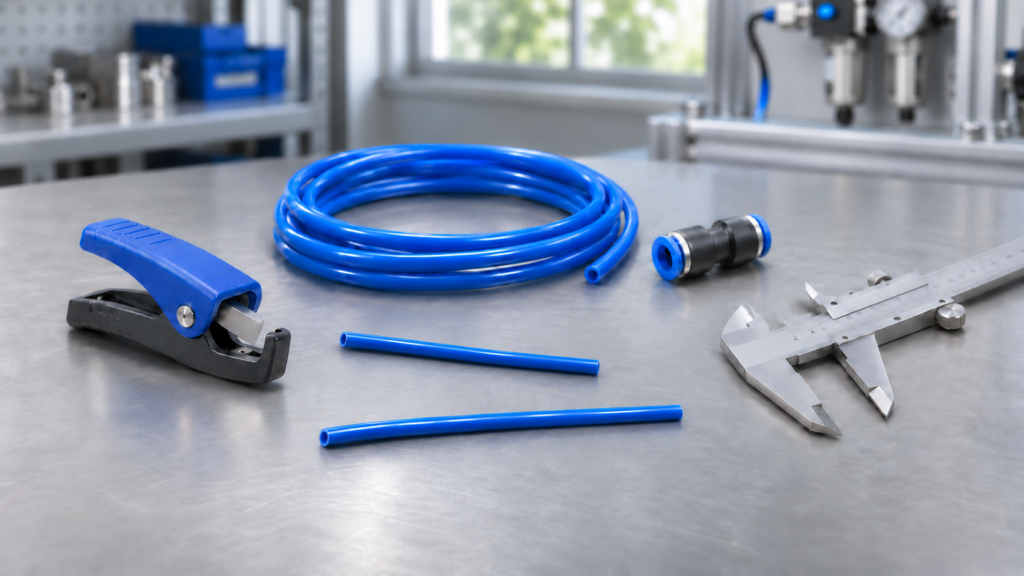
Industrial tubing failure can appear as a leak, kink, tube pullout, or burst. This guide explains seven operating and installation causes, plus a documentation check, to help you investigate the symptom and select a suitable replacement.
Before troubleshooting: make the equipment safe
Before disconnecting, cutting, or reinserting tubing, trained personnel should follow the equipment shutdown and energy-isolation procedures. Prevent unexpected movement or falling loads, isolate the air supply and relevant power sources, release stored pressure, and verify a safe state. Do not disconnect or repair a pressurized line. Follow the equipment instructions for testing and safe restart.
A leaking or damaged pneumatic tube can interrupt production, reduce machine performance and create avoidable maintenance work. But the visible symptom does not always point to a defective tube. The cause may be an unsuitable pressure or temperature condition, a fitting mismatch, poor installation, tight routing, chemical exposure or damage that occurred before the tube entered service.
This troubleshooting guide explains eight common causes of industrial and pneumatic tubing failure and what to check before replacing a line. Always verify the requirements for the exact tube, fitting and application; ratings and compatibility can vary by material, size, construction and test conditions.
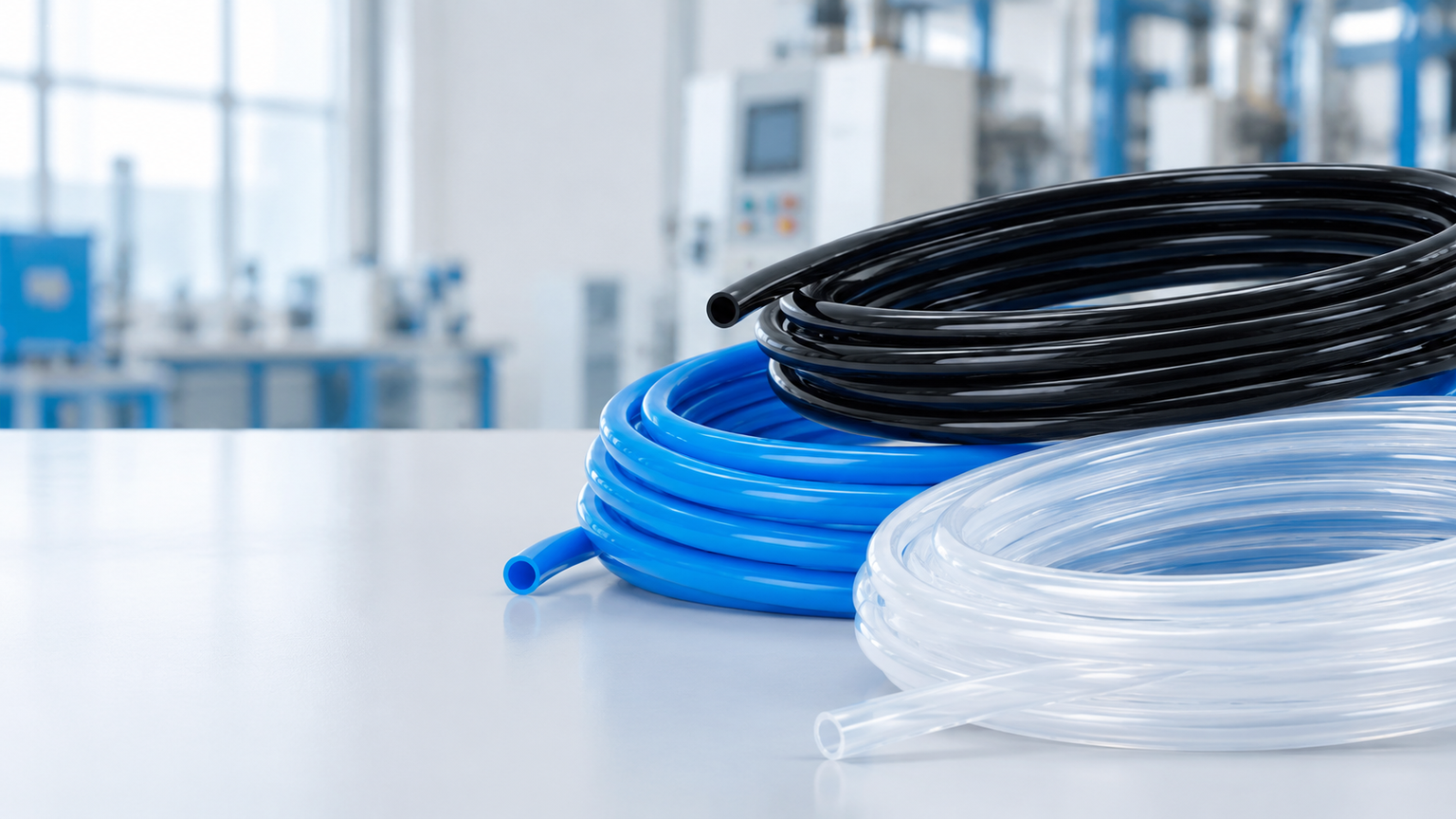
1. Actual pressure exceeds the applicable working limit
A tube can leak, swell or rupture when its actual service conditions exceed its allowable working pressure. Do not use burst pressure as the operating pressure: burst pressure describes failure under a particular test, not a recommended continuous operating condition. Pressure pulses, cycling, vibration and safety requirements also matter.
Check the specified working-pressure rating for the exact size and construction at the actual operating temperature. If pressure fluctuates or spikes, account for those conditions and confirm the selection with the tubing supplier or application engineer. Never estimate a safe rating from another size or material.
2. Operating temperature was overlooked
Pressure capability and flexibility may change with temperature. A rating stated at one reference temperature should not automatically be assumed to apply at a higher temperature. Heat near compressors, engines or process equipment—and cold environments that stiffen tubing—can contribute to leaks, cracking or movement at fittings.
Record the expected minimum and maximum tube temperature, including exposure to hot surfaces and cleaning cycles. Check the manufacturer’s pressure-temperature information for the selected part number. If the published data does not cover the real conditions, request written confirmation before installation.
3. Tube OD does not match the fitting
Push-in fittings generally seal and grip on the tube outside diameter (OD). A tube with the wrong OD, an out-of-tolerance OD or an unsuitable surface may leak or pull out even if its inside diameter appears correct. Nominal size labels alone may not be enough to confirm compatibility.
Verify the fitting’s accepted tube OD and the tube’s measured OD and tolerance. Check that the tube and fitting are intended to work together and that the tube end is not oval, scratched or damaged. Do not select a push-in fitting by matching only the tube ID.
4. Tube end was cut or inserted incorrectly
An angled, rough or crushed cut can prevent a reliable seal. Incomplete insertion may leave the tube short of the fitting’s sealing area; excessive force or repeated removal can damage the tube end. Debris left inside the tube can also affect the pneumatic system.
Use a suitable tube cutter to make a clean, square cut. Keep the end free of burrs and contamination, insert it to the fitting manufacturer’s specified depth, and perform the specified pull-check. Follow the fitting maker’s installation instructions; avoid improvising insertion-depth marks or tools.
5. Bend radius is too small or routing is constrained
A tight bend can flatten or kink a tube, restrict airflow and concentrate stress. Repeated flexing, torsion or rubbing against a sharp edge may accelerate damage. Minimum bend radius is not a universal number: it depends on material, tube dimensions, wall construction, temperature and how the radius is defined or tested.
Use the bend-radius value specified for the exact tubing, and clarify whether it refers to static or dynamic use when that distinction matters. Route the line without forcing a bend, twisting the tube or placing it under tension. Use suitable supports and protect it from abrasion and moving parts.
6. Material is incompatible with the medium or environment
A tube that works with compressed air in one setting may not be suitable for oil, fuel, cleaning chemicals, moisture, UV exposure or another process medium. Compatibility depends on the exact polymer, additives, concentration, temperature, exposure time and pressure. “Chemical resistant” is not a blanket guarantee.
Identify every fluid or gas that contacts the tube, plus external exposures and cleaning agents. Check the supplier’s compatibility data for the exact grade and conditions. For food, drinking-water or other regulated service, verify that the exact product and documents cover the intended application; do not infer approval from a material name alone.
7. Tube was damaged in storage, handling or installation
Cuts, crushing, kinks, sharp bends, prolonged exposure to sunlight or contact with heat and chemicals can weaken tubing before commissioning. Damage may be difficult to see at first and later appear as leakage or cracking.
Inspect reels and cut lengths on receipt and before installation. Store tubing within the supplier’s stated conditions, keep it clean and protected, and avoid dragging it over sharp surfaces. During installation, prevent crushing, twisting and contact with hot components. Replace tubing with visible damage rather than trying to repair a pressure line informally.
8. Check the evidence: certificates and generic datasheets
This is a selection and documentation check, not a direct physical failure mechanism.
A company-level quality certificate does not by itself prove the pressure rating or suitability of every tubing product. Likewise, a test report only supports the product, sample, method and conditions it identifies. A catalog value for one size or material should not be applied to another without evidence.
Match documentation to the exact product code, material, dimensions, production lot where relevant, test method and stated conditions. Confirm that any requested certification is applicable to the exact product and intended use. If a parameter is essential but missing, ask the supplier for product-specific documentation before purchase.
Industrial Tubing Failure: Symptoms and Checks
Use the symptom to choose the next check in an industrial tubing failure investigation. A symptom can have several causes; confirm the operating conditions before deciding what to replace.
| Symptom | Checks to make | Possible next step |
|---|---|---|
| Leak at fitting | Tube OD/tolerance, cut quality, insertion depth, fitting condition, pressure and temperature | Re-cut and reinstall per fitting instructions; replace damaged components; verify compatibility. |
| Tube pops out | OD mismatch, incomplete insertion, pressure spikes, vibration, tube damage | Confirm fitting/tube pairing and insertion; review dynamic loads and pressure conditions. |
| Tube kinks | Bend radius, routing tension, torsion, temperature, unsupported spans | Reroute with the specified radius; support/protect the line or review tube selection. |
| Tube bursts or splits | Working pressure, pulses, temperature, chemical exposure, cuts or aging | Isolate safely, identify failure location and service conditions; confirm exact rating before replacement. |
| Cracks after months | UV/ozone/chemical exposure, heat, repeated flexing, storage or material suitability | Review environment and maintenance history; obtain compatibility confirmation. |
| Low flow | Kink/flattening, undersized ID, excessive length, blockage, fitting restrictions | Check the complete flow path and system design; do not assume tube OD alone determines flow. |
| Supplier ratings differ | Size, material, construction, temperature, test method and rating definition | Compare like-for-like datasheets and ask suppliers to clarify conditions in writing. |
Replacement Checklist After Industrial Tubing Failure
- Application and medium (including cleaning agents and external exposure)
- Required operating pressure, pressure peaks/pulses and expected cycle
- Minimum and maximum service temperature
- Tube OD, ID, wall thickness, tolerances and required length
- Fitting make/type and its accepted tube OD
- Routing, bend radius, motion, vibration and abrasion risks
- Applicable standards or certificates, tied to the exact product and use
- Required product-specific datasheet and test documentation
Preventing Repeat Industrial Tubing Failure
Industrial tubing failure may result from operating conditions, installation, or damage, rather than a material defect alone. Start with the failure location and operating conditions, then check pressure and temperature, tube-to-fitting dimensions, cutting and insertion, bend radius, compatibility and handling history. Use data for the exact tubing size and construction, and ask for clarification whenever a rating or certificate does not cover the intended service.
Need help specifying industrial tubing? Send YUANNAI TUBE the required material, dimensions, working conditions and fitting details so the product options can be reviewed against your application.
Related technical guides
- Pneumatic Tubing Size Chart
- Tubing Pressure & Temperature
- Air Tubing Kinking: Causes & Bend Radius
- How to Cut Plastic Tubing: Square-Cut Steps
- Tubing & Push-In Fittings
- Tubing Receiving Inspection
- Tubing Specifications
- Contact the Tubing Manufacturer
Source and scope
The safety guidance is informed by the maintenance section of SMC manual DOC1063304-1 (PDF, printed page 9). Follow the instructions for your actual equipment.