Quick Answer: Should You Choose FEP or PFA Tubing? (FEP vs. PFA / PFA vs. FEP)
Compare FEP vs PFA tubing by process temperature, medium, dimensions, minimum bend radius and documentation requirements. The current YN-FEP sheet lists -196°C to +200°C and YN-PFA lists -200°C to +260°C as finished-product service temperature ranges. Matched sizes have equal working pressures at 23°C, while their bend-radius values differ by model.
Both ranges offer transparent tubing. For optical, semiconductor or other cleanliness-sensitive service, specify the required measurements, grade, cleaning, packaging and supporting test documents together with the size.
Quick Overview: FEP vs. PFA Core Differences
The table below uses the current company-supplied finished-tubing sheets. General resin information is listed separately under Sources.
| Published specification | YN-FEP tubing | YN-PFA tubing | How to use it |
|---|---|---|---|
| Finished-product service temperature range | -196°C to +200°C | -200°C to +260°C | Compare the process temperature and the relevant pressure data separately. |
| Working pressure at 23°C | 6–20 bar across the listed models | 6–20 bar across the listed models | The matched sizes have equal room-temperature working pressures. |
| Minimum bend radius | 13–160 mm, depending on size | 14–128 mm, depending on size | Compare the exact row; neither material has the smaller radius at every size. |
| Standard appearance / colors | High-transparency clear, transparent blue and transparent red | High-transparency clear | Use a sample to assess visibility and any optical requirement. |
| Hardness in the supplied sheet | 55 ± 5 Shore D | 60 Shore D | Review fitting and forming requirements for the exact tubing. |
| Standard packaging | Stretch-film wrapping | Stretch-film wrapping | State any additional cleanliness or packaging requirements with the inquiry. |
Model-by-Model Specification Comparison (YN-FEP vs. YN-PFA)
Review the same nominal OD/ID in each material. Working pressures are at 23°C; the original model values and bar/psi pairs are retained below.
| Model / nominal size | OD × ID (mm) | Wall (mm) | FEP Working Pressure | FEP Min. Bend Radius | PFA Working Pressure | PFA Min. Bend Radius |
|---|---|---|---|---|---|---|
| YN-FEP 0425 / YN-PFA 0425 | 4.0 × 2.5 | 0.75 | 16 bar (224 psi) | 25 mm | 16 bar (224 psi) | 30 mm |
| YN-FEP 0640 / YN-PFA 0640 | 6.0 × 4.0 | 1 | 17 bar (238 psi) | 40 mm | 17 bar (238 psi) | 36 mm |
| YN-FEP 0850 / YN-PFA 0850 | 8.0 × 5.0 | 1.5 | 20 bar (280 psi) | 60 mm | 20 bar (280 psi) | 50 mm |
| YN-FEP 0855 / YN-PFA 0855 | 8.0 × 5.5 | 1.25 | 20 bar (280 psi) | 65 mm | 20 bar (280 psi) | 55 mm |
| YN-FEP 0860 / YN-PFA 0860 | 8.0 × 6.0 | 1 | 13 bar (182 psi) | 70 mm | 13 bar (182 psi) | 64 mm |
| YN-FEP1065 / YN-PFA1065 | 10.0 × 6.5 | 1.75 | 19 bar (270 psi) | 80 mm | 19 bar (270 psi) | 80 mm |
| YN-FEP 1080 / YN-PFA 1080 | 10.0 × 8.0 | 1 | 14 bar (196 psi) | 110 mm | 14 bar (196 psi) | 88 mm |
| YN-FEP 1280 / YN-PFA 1280 | 12.0 × 8.0 | 2 | 18 bar (261 psi) | 100 mm | 18 bar (261 psi) | 72 mm |
| YN-FEP 1410 / YN-PFA 1410 | 14.0 × 10.0 | 2 | 12 bar (168 psi) | 120 mm | 12 bar (168 psi) | 98 mm |
| YN-FEP 1612 / YN-PFA 1612 | 16.0 × 12.0 | 2 | 10 bar (145 psi) | 160 mm | 10 bar (87 psi) | 128 mm |
| 1/8″ | 3.175 × 1.58 | 0.797 | 16 bar (232 psi) | 13 mm | 16 bar (232 psi) | 14 mm |
| 1/4″ | 6.350 × 4.35 | 1 | 10 bar (145 psi) | 50 mm | 10 bar (145 psi) | 37 mm |
| 3/8″ | 9.525 × 6.35 | 1.588 | 10 bar (145 psi) | 26 mm | 10 bar (145 psi) | 40 mm |
| 1/2″ | 12.70 × 9.60 | 1.55 | 6 bar (87 psi) | 130 mm | 6 bar (87 psi) | 100 mm |
Review working pressure at the process temperature using the relevant model data and the pressure-temperature guide. The 23°C values and service-temperature ranges describe separate conditions.
1. Continuous Operating Temperature and Thermal Stability
The supplied YN-FEP sheet lists -196°C to +200°C and a melting temperature of approximately 260°C. The YN-PFA sheet lists -200°C to +260°C and a melting temperature of approximately 300–310°C.
For hot or cryogenic lines, specify the actual temperature, medium, pressure, thermal cycles and connection design. Evaluate these conditions together using the selected grade and finished-tubing documentation.
2. Optical Clarity and UV Transmittance
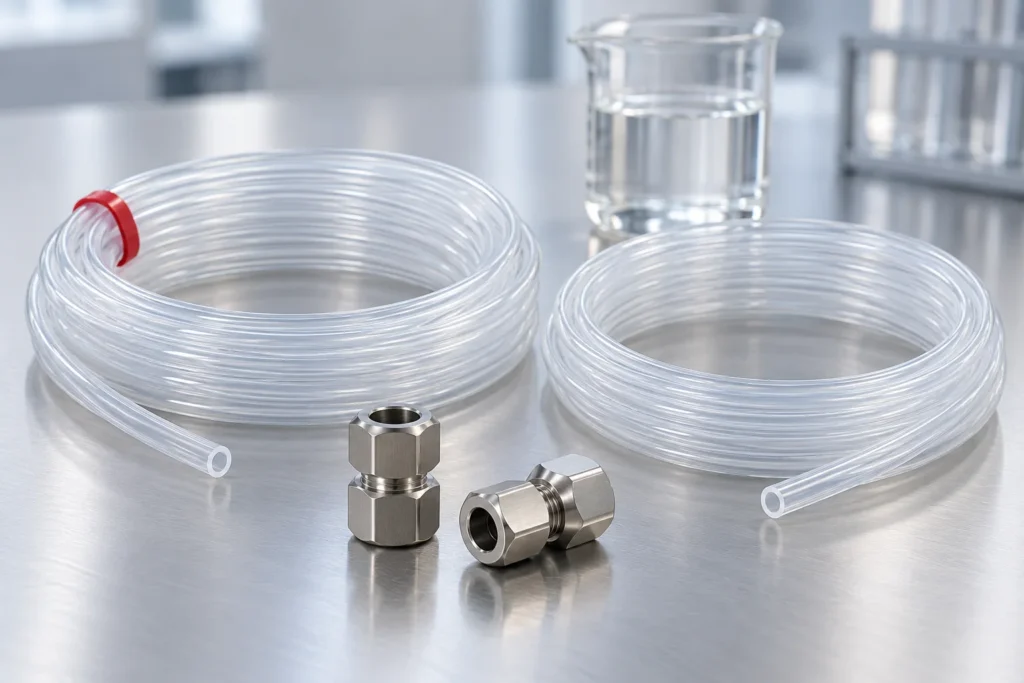
The product sheets describe both ranges as high-transparency clear; FEP also has transparent blue and red options. Assess fluid visibility on a sample at the required wall thickness and with the actual liquid.
For a UV or analytical process, specify wavelength, required transmission and the measurement method. Use grade- and wall-specific optical data to evaluate that requirement.
3. Purity, Trace Metal Leaching, and Semiconductor Cleanliness

For a high-purity PFA tubing project, provide the required resin grade, extractables, ionic/metal limits, TOC, cleaning, inspection and packaging specification. Review the corresponding documentation for the finished tubing before approving the material.
Where a project calls for SEMI F57 or another standard, include that standard in the inquiry and request the relevant qualification documents. Material-family selection, finished-tubing testing and project approval are separate parts of the specification.
4. Flex Fatigue Life and PFA Tubing Fittings
Use the listed minimum bend radius for static routing. For repeated movement, specify the motion radius, travel, speed, cycle count, temperature and fittings, then review a test representative of the installed assembly.
For flared or compression fittings, use the connection manufacturer’s approved material and dimensional requirements. Review the formed connection and sample assembly under the intended service conditions.
5. Decision Checklist: Matching Material to Your Application
- Specify OD, ID, tolerance and the required roll length.
- Compare working pressure at the actual process temperature.
- Identify the exact chemical, concentration and exposure conditions.
- Compare model-specific bend radius and any dynamic-motion test.
- State optical, purity, cleaning and qualification requirements explicitly.
- Review a sample and supporting documents for the offered grade.
Frequently Asked Questions
What is FEP tubing and when is it preferred over PFA?
FEP is a melt-processable fluoropolymer used for fluid tubing. The YN-FEP sheet lists a finished-product service temperature range of -196°C to +200°C, clear and transparent color options, and size-specific pressure and bend-radius values. Compare these specifications and a sample with the required chemical and optical conditions.
What is high-purity PFA tubing used for in semiconductor manufacturing?
High-purity PFA grades are used in demanding chemical-handling and semiconductor applications. Specify the required resin grade, extractables/TOC limits, cleaning, packaging and test documents. For a requirement such as SEMI F57, review the supporting documents for the specific finished tubing offered.
Which fittings work best with FEP and PFA tubing (Swagelok / flare fittings)?
Choose fittings approved for the exact material, OD, wall, pressure, temperature and medium. For compression or flared connections, follow the fitting manufacturer’s tubing specification and assembly instructions, then review the assembled connection under the intended service conditions.
Can FEP and PFA be heat-welded or thermal-formed?
Both are melt-processable fluoropolymers. Discuss the required bend shape or formed connection, dimensions, wall and tooling with the supplier, and approve a sample made using the proposed process. The source sheets list different melting temperatures; process settings should follow the actual grade and equipment.
Is PFA chemically more resistant than FEP?
Use the selected resin grade and chemical compatibility data at the actual concentration, temperature and pressure. Compare the relevant chemical-resistance information and service limits, then confirm the specific tubing against the process requirements.
How do FEP and PFA compare to PTFE tubing?
FEP and PFA are melt-processable fluoropolymers, while PTFE uses different processing methods. For material-family background and application questions, see the PTFE, FEP and PFA guide and the relevant grade’s technical documentation.
Why does PFA cost more than FEP?
Compare quotations for the same size, grade, quantity and documentation. Resin grade, manufacturing process, testing and packaging can change the quotation; specify these requirements together for a meaningful FEP/PFA comparison.
What coil packaging and tolerances are provided?
Both current sheets list ±0.10 mm dimensional tolerance and stretch-film wrapping. Roll length is model-specific in the product tables. Include any tighter tolerance, clean packaging or special coil requirement in the OEM inquiry for review.
Sources and Related Fluoropolymer Guides
Finished-tubing values: company-supplied TDS-FEP-2026-V6 and TDS-PFA-2026-V7, available in the product data sheet center. Checked against the product model tables on November 2, 2026.
General resin-family background: Chemours describes FEP resins and PFA resin grades and processing. Those references concern the resin grades described by their manufacturer; use the offered tubing’s own documents for project approval.
- FEP tubing models and data sheet
- PFA tubing models and data sheet
- PTFE vs FEP vs PFA guide
- Chemical compatibility guide and sources
- Discuss your tubing requirements
Sources and scope
Use these documents for the identified product models and stated test conditions. General material comparisons and selection checklists do not establish a different grade’s rating, fitting compatibility or project approval. Confirm the exact model, medium, temperature, pressure and required evidence before ordering.
Content review: zhangkexin · Marketing
Review scope: market information and document references.