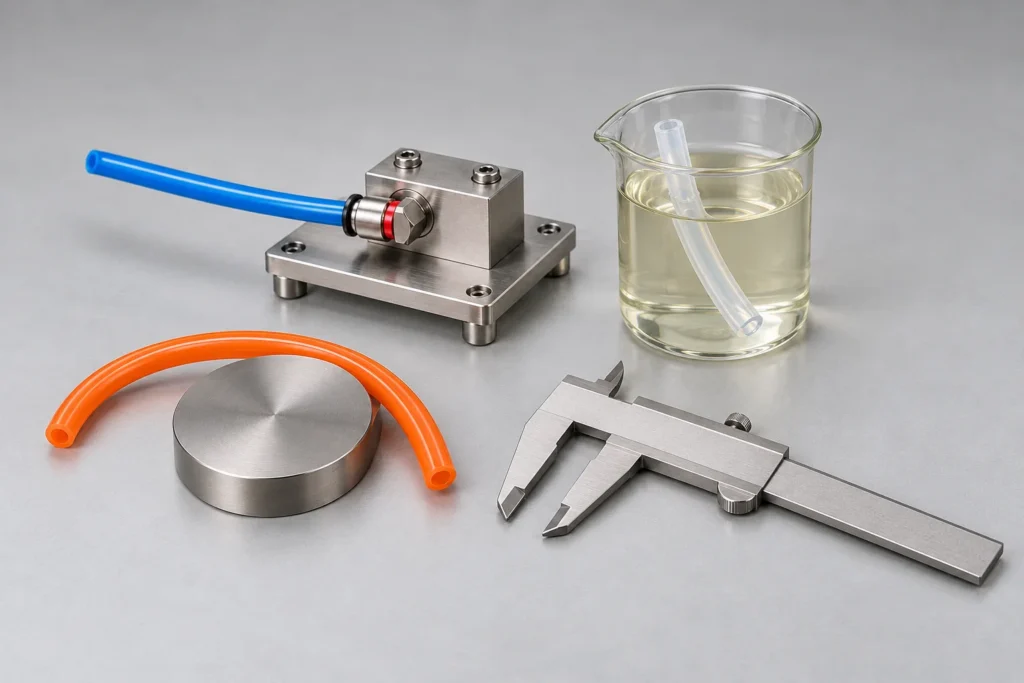
A sample answers questions a data sheet cannot: does the tube fit your fitting, hold your pressure, bend around your route and survive your medium. Plan the sample in six tests, write the pass criteria from your specification before the sample arrives, and keep a reference piece from every lot you approve.
Quick answer. Test samples in this order: dimensions, appearance, fit in your fittings, leak test at or below working pressure, bend at your tightest radius, and soak in your medium. Use the values in your written specification as the pass criteria, and record each result against the model row.
Order the sample
Standard specifications can be sampled at 1–3 m. The customer pays the sample fee and shipping; the sample fee can be credited against the first bulk order placed within 6 months, and shipping is not credited. Order the exact model you intend to buy, not a similar size, so the results apply to the bulk order. If the model is not settled yet, compare the size tables first.
Plan the cut
A 3 m sample covers every test when you cut it before you start. A workable plan:
| Piece | Length | Used for |
|---|---|---|
| Reference | 0.3 m | Kept sealed and untouched as the approved reference for this lot |
| Fit and leak | 1.0 m | Fittings, pressure hold |
| Bend | 0.5 m | Tightest-radius check, with and without pressure |
| Medium soak | 0.5 m | Exposure to your medium at your temperature |
| Spare | 0.7 m | Repeat any test that gives an unclear result |
Six tests
| Test | How to run it | Pass when |
|---|---|---|
| 1. Dimensions | Measure OD and ID at several points with a caliper or pin gauge; compute wall | Values sit inside the tolerance stated in the model row |
| 2. Appearance | Check color, surface, ends and roundness against the reference photo or sample | No kinks, flat spots, bubbles or color streaks |
| 3. Fit | Insert into your actual push-in or compression fitting and pull by hand | Seats fully, holds, releases cleanly |
| 4. Leak | Pressurize at or below the model’s working pressure at room temperature, with a guard in place | No leak and no visible change over the hold time you set |
| 5. Bend | Route the tube around a gauge at your tightest radius, then pressurize | No kink, flow stays open, radius is at or above the model’s minimum |
| 6. Medium soak | Immerse a piece in your medium at your operating temperature for your chosen time | No swelling, cracking, softening or color change beyond what you accept |
Run pressure tests at or below the working pressure listed for the model, behind a guard. Burst pressure is a test value for the data sheet, not a bench target. Where a line moves, repeat test 5 at the cycle count the route sees.
Record and decide
- Write the result for each test next to the model code and lot or batch reference.
- Photograph the sample and the reference piece together.
- Set the accept, repeat or reject decision before you read the results, using the criteria from your specification.
- Send the record with your bulk inquiry so the quotation matches the tested model.
After approval
The approved sample becomes the reference for incoming goods. Compare each delivery with it and with the order using the receiving inspection checklist. For the supplier side of the decision, see how to choose a tubing supplier.
Frequently Asked Questions: Testing Tubing Samples
How long a sample do I need?
1–3 m covers the six tests with the cut plan above. YUANNAI TUBE samples standard specifications at 1–3 m.
Who pays for tubing samples?
At YUANNAI TUBE the customer pays the sample fee and shipping. The sample fee can be credited against the first bulk order placed within 6 months; shipping is not credited.
What pressure should I test a sample at?
At or below the working pressure listed for the model at room temperature, behind a guard. Check the value in the model table and the working pressure and temperature guide before testing at higher temperatures.
Is a sample test the same as incoming inspection?
No. A sample test decides whether a model suits your application before you order. Incoming inspection checks each delivery against the order and the approved sample.
Next step. Request a sample of the exact model through the contact form, or download the data sheet first from the data sheet page.
Sources and scope
- PA6 Nylon Tubing — English data sheet (v4-20261020)
- PA12 Nylon Tubing — English data sheet (v5-20261020)
- Polyether Tubing — English data sheet (v2-20261020)
- FEP Tubing — English data sheet (v6-20261020)
Use these documents for the identified product models and stated test conditions. General material comparisons and selection checklists do not establish a different grade’s rating, fitting compatibility or project approval. Confirm the exact model, medium, temperature, pressure and required evidence before ordering.
Content review: zhangkexin · Marketing
Review scope: market information and document references.