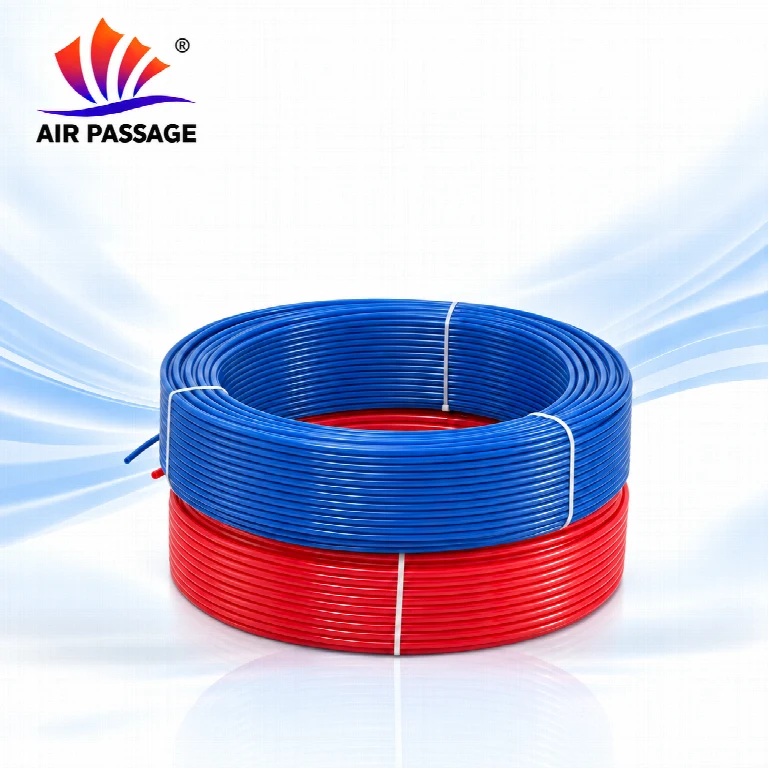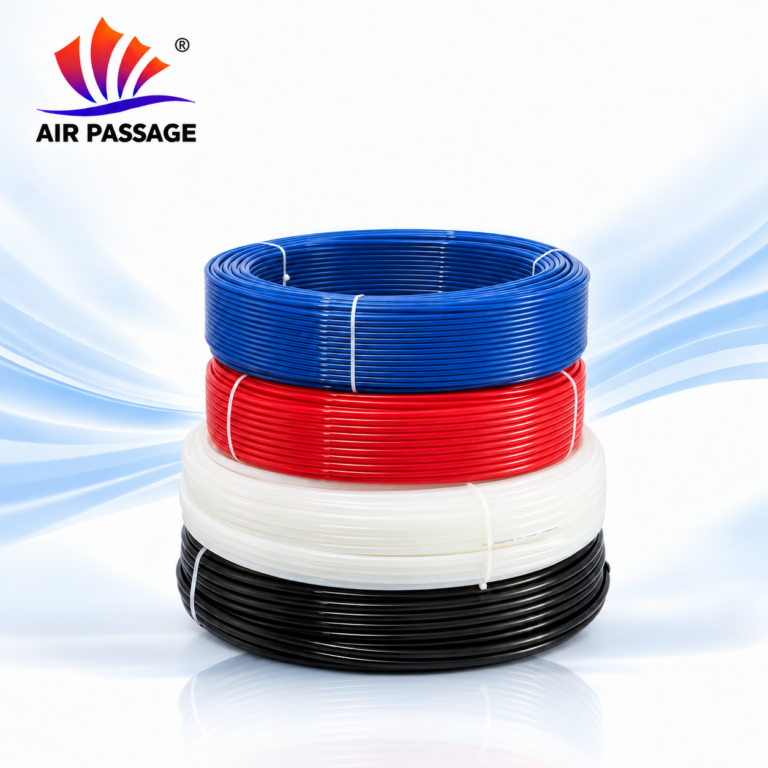
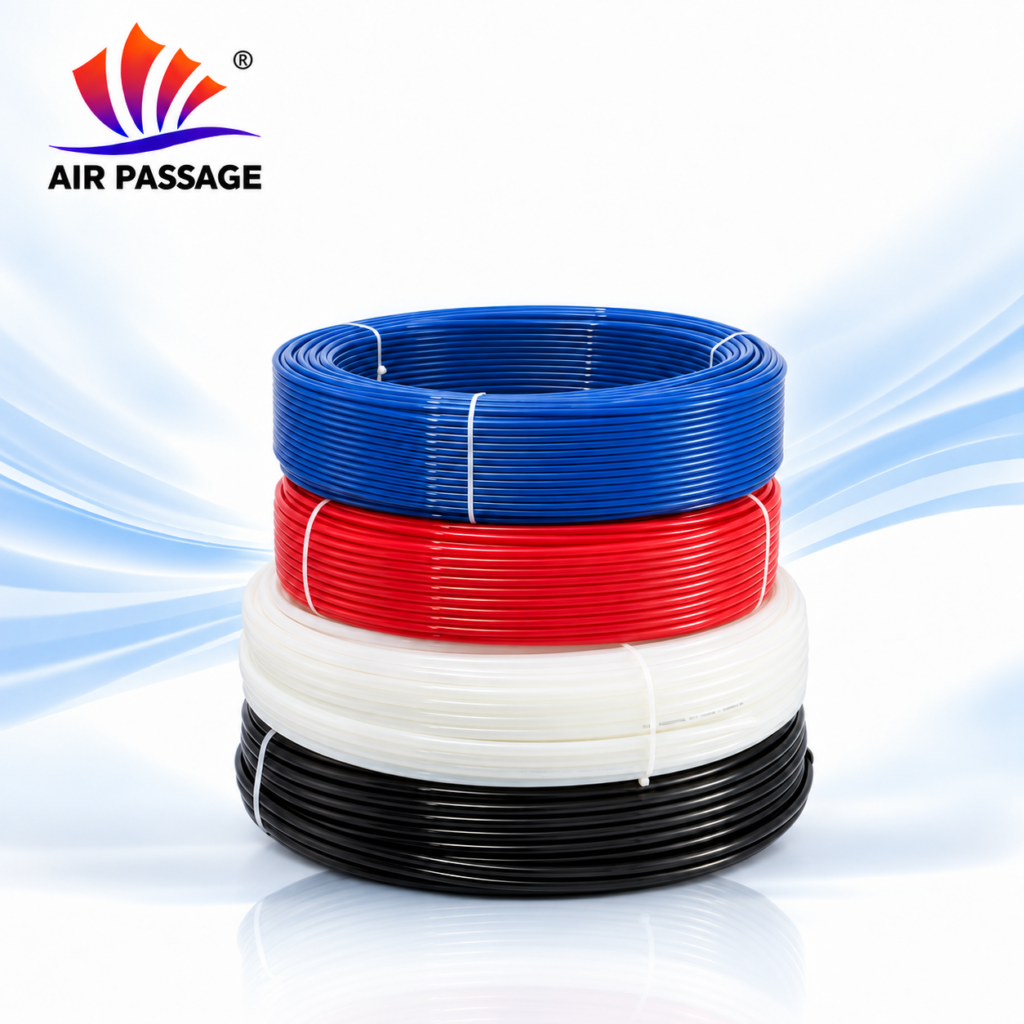
In Northeast China, farm machinery meets low temperatures in early- and late-season work and during winter storage and maintenance. One agricultural machinery customer changed the tubing in its seed and fertilizer delivery system from PA6 to PA12, with low-temperature flexibility as the deciding consideration.
- Application
- Seed and fertilizer delivery
- Region
- Northeast China
- Material
- PA6 replaced by PA12
- Deciding factor
- Low-temperature flexibility
Quick summary. PA12 generally keeps more flexibility than PA6 in the cold, which can make tubing easier to route and handle when the machine is cold. Flexibility does not set pressure, though: in our 2026 data sheets PA12 is listed at a lower working pressure than PA6 in 9 of the ten shared metric sizes and at a higher one in 1, all at 23 °C. Choose from the row for your model.
The low-temperature challenge
As temperatures fall, tubing becomes stiffer and harder to bend. On agricultural machinery that makes it harder to route tubing through compact spaces and to handle it during installation and maintenance.
When selecting tubing for a seed and fertilizer delivery system, check:
- Operating temperatures, including storage and maintenance conditions
- Available routing space and the bend radius it requires
- System pressure and the pressure rating of the selected tube
- Compatibility between the tubing and the fittings
- The conveyed material and the service conditions around it
Why the customer switched from PA6 to PA12
The customer changed the tubing in its seed and fertilizer delivery system from PA6 to PA12 to meet a low-temperature flexibility requirement.
PA12 generally retains more flexibility in the cold. Compared with PA6, PA12 generally stays more flexible at low temperatures. Depending on the tubing specification and application, that can make the tube easier to bend and route when the equipment is cold, particularly where installation space is limited. Our data sheets point the same way on the material: PA12 is listed at 65 ± 5 Shore D and PA6 at 75 ± 5 Shore D.
Flexibility does not decide pressure on its own. A softer tube is not automatically a lower-pressure tube, and a stiffer one is not automatically a higher-pressure tube. Pressure depends on diameter, wall thickness, construction, temperature and the fitting. The data sheets below show how the two materials are listed in the same sizes.
PA6 and PA12 side by side
| Factor | PA6 | PA12 |
|---|---|---|
| Low-temperature flexibility | Can become stiffer as temperature decreases | Generally retains better flexibility at low temperatures |
| Bending and routing | Can be harder when cold, depending on the specification and conditions | Can be easier when cold, depending on the specification and conditions |
| Pressure suitability | Depends on the tube specification and operating conditions | Depends on the tube specification and operating conditions |
| Fitting compatibility | Confirm for the selected tube and fitting combination | Confirm for the selected tube and fitting combination |
This table describes general material characteristics. Actual performance depends on the tubing construction, dimensions, fittings and application conditions.
The same ten sizes in our data sheets
Ten metric model codes exist in both ranges with identical dimensions and the same ±0.10 mm tolerance. The figures are listed at 23 °C, so they show how the two materials are rated in the same size, not how either tube behaves in the cold.
| Model (OD×ID, mm) | PA6 working pressure | PA12 working pressure | PA6 min. bend | PA12 min. bend |
|---|---|---|---|---|
| 0425 (4×2.5) | 41 bar | 29 bar | 40 mm | 20 mm |
| 0640 (6×4) | 35 bar | 27 bar | 35 mm | 30 mm |
| 0850 (8×5) | 28 bar | 29 bar | 45 mm | 30 mm |
| 0855 (8×5.5) | 28 bar | 19 bar | 47 mm | 45 mm |
| 0860 (8×6) | 23 bar | 17 bar | 48 mm | 50 mm |
| 1065 (10×6.5) | 31 bar | 24 bar | 65 mm | 80 mm |
| 1080 (10×8) | 18 bar | 14 bar | 80 mm | 85 mm |
| 1280 (12×8) | 22 bar | 16 bar | 70 mm | 93 mm |
| 1410 (14×10) | 25 bar | 12 bar | 140 mm | 75 mm |
| 1612 (16×12) | 22 bar | 14 bar | 160 mm | 95 mm |
PA12 is listed at a lower working pressure in 9 of the ten sizes and a higher one in 1 (8×5). The listed bend radius is smaller for PA12 in 6 sizes and larger in 4. In the fractional sizes the two materials share the same working pressure. Read the row for your own model rather than the trend.
Choosing tubing for seed and fertilizer delivery
Tubing is one part of the system. Review the tube, the fittings, the routing, the operating conditions and the conveyed material together. Before you choose, confirm:
- Temperature range: include operating, storage and maintenance conditions.
- Pressure: read the rating for the exact tube specification.
- Routing: check the space available and the bend radius required.
- Fittings: confirm they suit the tube and the installation method; see matching tubing to fittings.
- Application: consider the conveyed material and other service conditions.
For bend radius in practice, see tubing bend radius and routing; for how temperature and pressure interact, working pressure and temperature.
PA12 tubing from YUANNAI TUBE
Our PA12 nylon tubing is listed in 14 models: metric sizes from 2.5 × 4 mm to 12 × 16 mm and fractional sizes from 1/8″ to 1/2″, in 100 m or 200 m rolls with a ±0.10 mm tolerance. Working pressure at 23 °C runs from 10 to 29 bar depending on the model, and the pneumatic operating range is −40 °C to +120 °C. For PA6 the pneumatic range is −40 °C to +130 °C; see the PA6 nylon tubing page. For the wider comparison, read PA6 vs PA12 nylon tubing, and for other farm machinery uses, agricultural equipment tubing.
Sources: PA6 data sheet (TDS-PA6-2026-V4) and PA12 data sheet (TDS-PA12-2026-V5).
Conclusion
The customer’s change from PA6 to PA12 for seed and fertilizer delivery shows why material should be matched to operating conditions. PA12 generally stays more flexible than PA6 in the cold, which suits cold-weather bending and routing. A softer tube should not be read as a lower or higher pressure rating: confirm the exact specification, fittings and operating conditions.
PA12 vs PA6 for cold climates FAQ
Why did the customer change from PA6 to PA12?
To meet a low-temperature flexibility requirement in the seed and fertilizer delivery system of its agricultural machinery in Northeast China.
Is PA12 more flexible than PA6 in cold weather?
Generally yes. PA12 usually retains more flexibility than PA6 at low temperatures, and our data sheets list it at a lower Shore D hardness (65 ± 5 against 75 ± 5). The effect depends on the tube specification and conditions.
Does a softer tube mean a lower pressure rating?
Not by itself. Pressure depends on diameter, wall thickness, construction, temperature and fitting. In our data sheets PA12 is listed at a lower working pressure than PA6 in 9 of ten shared metric sizes, so check the model row.
What temperature range is listed for PA12 tubing?
The pneumatic operating range is −40 °C to +120 °C for PA12 (and −40 °C to +130 °C for PA6), with pressure ratings stated at 23 °C.
What should I confirm before choosing tubing for seed and fertilizer delivery?
The temperature range including storage and maintenance, the pressure rating of the exact specification, the bend radius your routing needs, fitting compatibility, and the conveyed material.
Cold-climate tubing for your machinery?
Send us your temperature range, pressure, tube size, routing space and fittings. We review them with you, recommend a PA6 or PA12 specification and quote samples in your size.