Coiled air tubing: the short answer
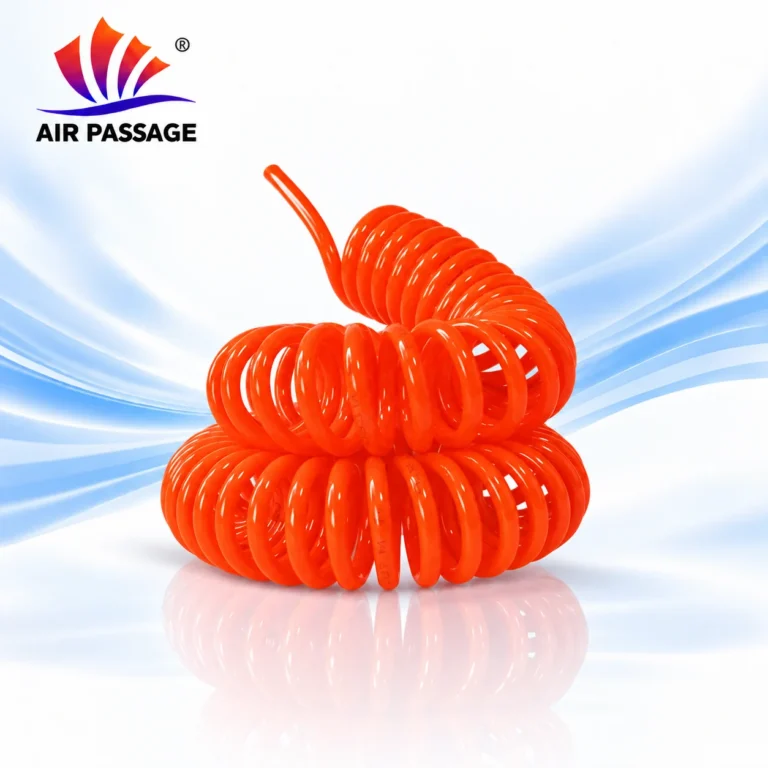
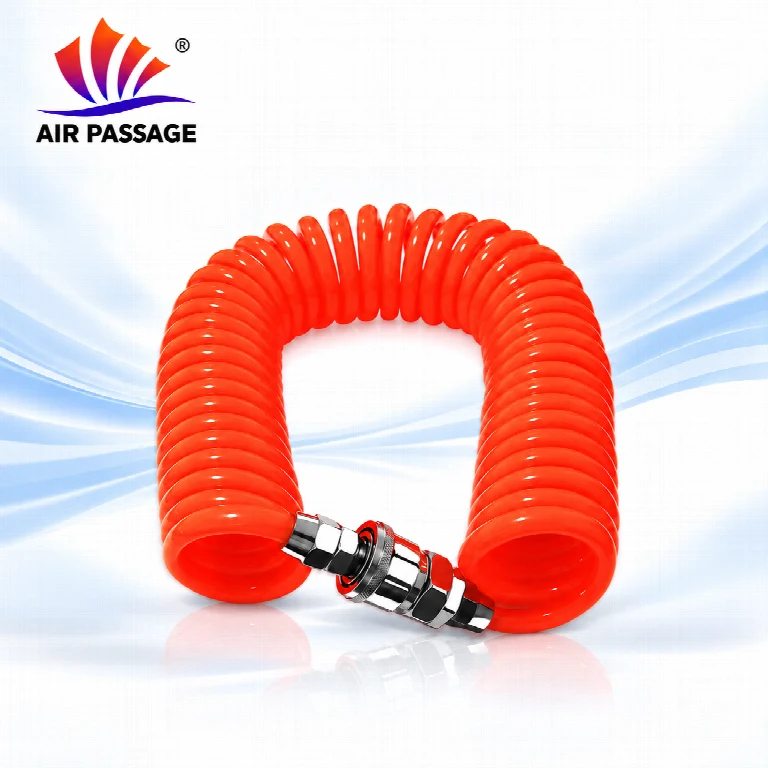
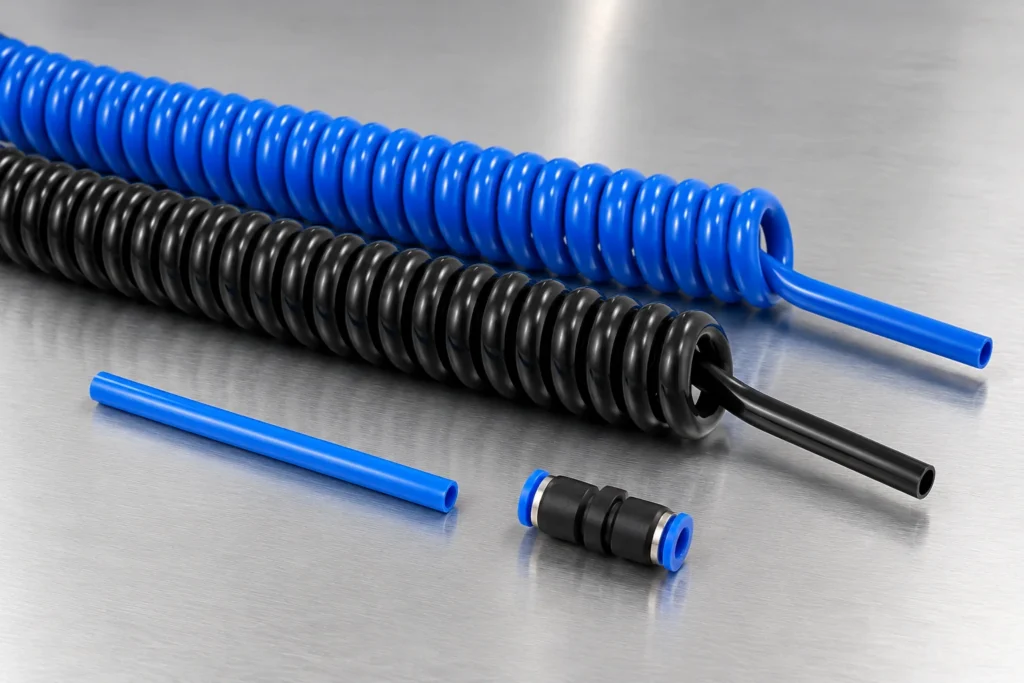
Coiled air tubing (recoil tubing, Spiralschlauch in German) is tubing formed into a spiral so it stretches when you pull it and returns to its coiled shape when released. It suits a moving connection such as a hand tool, a tool changer or a moving machine axis. We list it as PU recoil tubing and polyether recoil tubing, in metric sizes from 4/2.5 mm to 16/12 mm and in inch sizes from 1/8 in to 3/4 in.
The tube size alone does not tell you how far a coil reaches. Send the coil dimensions, the working reach and both end connections with your request.
What a coiled air hose is, and where it is used
A straight tube needs a fixed route and enough free length to follow the movement. A coiled tube stores that length in the spiral. That is why coiled tubing is chosen for connections that move: a pneumatic tool on a workbench, a hand-held tool that is picked up and put down, or a moving head on a machine. The tube is the same type of tubing as in our straight ranges; the coil is added by forming.
PU or polyether spiral tubing
Both families are polyurethane. The difference is the base polymer. Polyether polyurethane resists hydrolysis, the breakdown by water, better than polyester-based polyurethane, which matters in damp air and where water is present. Our guide to polyether and polyester PU tubing explains the difference.
- PU recoil tubing: the supplied data lists air as the medium. Confirm it against your exact service conditions.
- Polyether recoil tubing: the supplied data lists air, water and oil. Confirm the medium and the material designation for your application.
What to send with a coiled tubing inquiry
The tube ID and OD, the coil geometry and the working reach are three separate things. Usable reach, pull force and fatigue life depend on the whole assembly, not on the straight-tube dimensions. For a quotation or a sample, state:
- Size: OD and ID in mm, written as OD/ID, for example 8/5.
- Material: PU or polyether.
- Coil: the retracted coil length and the coil diameter you can accept.
- Working reach: how far the coil must stretch in normal use and at its maximum.
- Ends: fitting type, thread or push-in size at each end, and any straight lead-in length.
- Conditions: medium, working pressure and temperature, and the quantity.
If you need the tubing supplied as an assembly with fittings already fitted, describe it on the OEM and custom tubing page.
Coiled or straight tubing
- Choose coiled tubing when the connection moves, when the tool is picked up and put down, or when the free length must be stored without a loose loop.
- Choose straight tubing for fixed runs, where the route is set and the bend radius is respected. See the bend radius guide.
- Use both on one machine: straight tubing from the valve to the last fixed point, and a coil for the moving last meter.
Installation points
- Fit the ends so the coil can move freely and is not twisted along its length.
- Keep the coil away from sharp edges and from hot parts.
- Check the complete assembly, tube and fittings, against the working pressure and temperature of your circuit.
Sizes we list for coiled tubing
The PU and polyether recoil tables list the same size range. Metric sizes are written OD/ID in mm; inch sizes are nominal. The full model tables are on the product pages.
| System | Sizes (OD/ID in mm) |
|---|---|
| Metric | 4/2.5, 5/3, 6/4, 8/5, 8/5.5, 8/6, 10/6.5, 10/7.5, 12/8, 14/10, 16/12, 16/13 |
| Inch (nominal) | 1/8 in (3.17/1.58), 1/4 in (6.35/4.35), 3/8 in (9.52/6.35), 1/2 in (12.7/9.6), 3/4 in (19.05/15.88) |
A metric size and the nearest inch size are different sizes. A 6/4 mm tube is not a 1/4 in tube. Use the tubing size chart to compare, and the unit converter to convert.
Frequently asked questions
Which sizes of coiled air tubing are available?
The tables list metric sizes from 4/2.5 mm to 16/12 mm and inch sizes from 1/8 in to 3/4 in, in PU and in polyether. Check the product page for the exact models.
How long is a coil when it is stretched?
It depends on the tube size, the coil diameter and the number of turns, so we do not give one figure. State the working reach you need and we review it against the coil geometry.
Can I get coiled tubing with the fittings already fitted?
Tube assemblies with pre-installed fittings are part of our OEM and custom tubing service. Send the fitting type, thread or push-in size and the working reach.
What working pressure does coiled tubing have?
Working pressure is a model-specific rating that applies to the complete assembly at a stated temperature. We do not quote one value here. Send your pressure and temperature and we confirm the model.
Request a sample or a quotation
Request a sample of standard tubing, or send your coil, reach and fitting details for a quotation: send your requirements or browse the product range.
Sources and scope
- PU Recoil Tubing — product information; request model-specific data
- Polyether Recoil Tubing — product information; request model-specific data
Use these documents for the identified product models and stated test conditions. General material comparisons and selection checklists do not establish a different grade’s rating, fitting compatibility or project approval. Confirm the exact model, medium, temperature, pressure and required evidence before ordering.
Content review: zhangkexin · Marketing
Review scope: market information and document references.